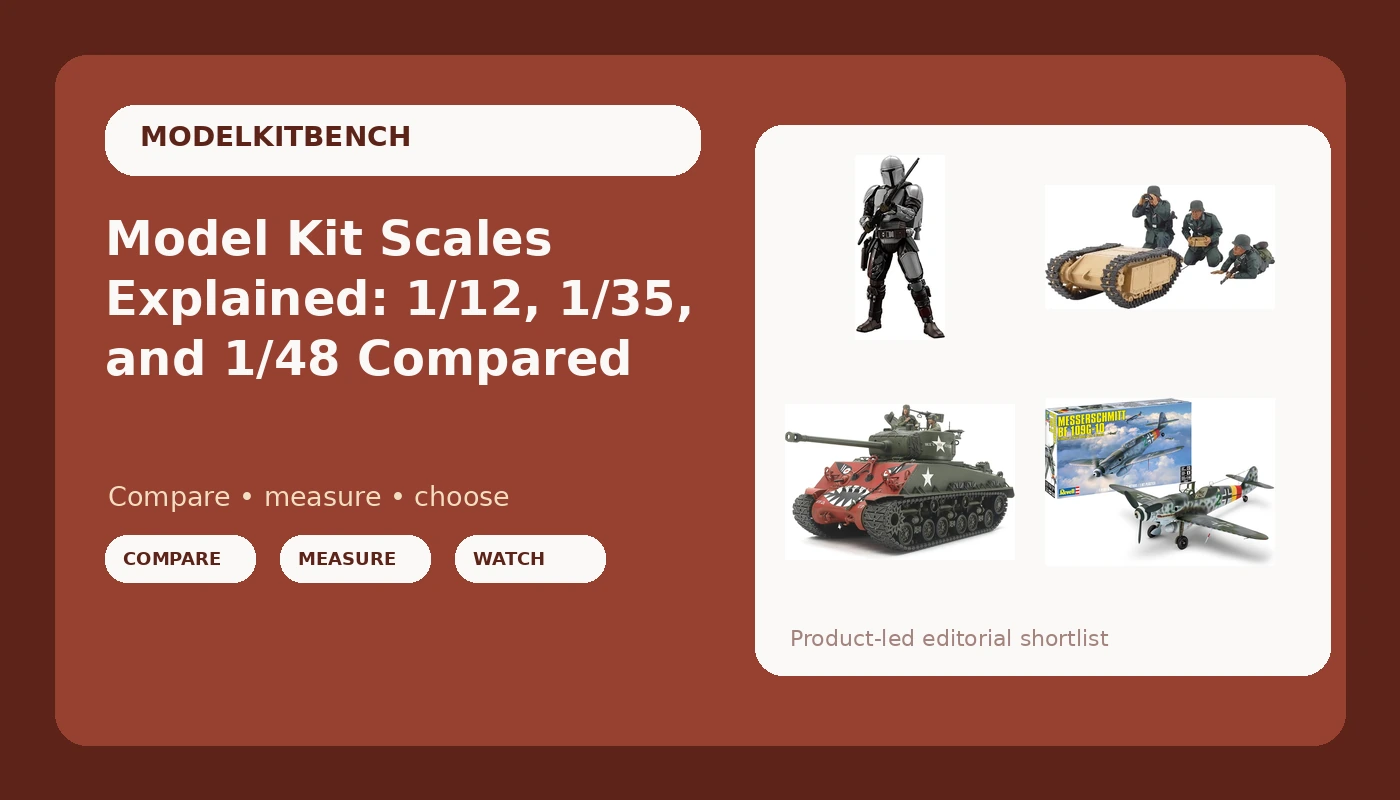
Related: Best Model Kits for Beginners: Snap-Fit Kits That Actually Fit
Related: Panel Lining Basics: One Pass, Big Difference
I built my first kit at 11, and the lesson I keep relearning is that model kit scales matter more than the subject on the box. Scale decides how much shelf you need, how much paint you burn through, how small the parts get, and whether a kit can live on a TV tray or needs a dedicated bench. Pick 1/35 armor and you will probably buy 1/35 armor for the next ten years. Pick 1/12 figures and you will run out of shelf space by spring.
So this is a guide to the choice underneath the kit: scale, subject, and how much work each one asks you to bring. Four kits, three scales, two armor subjects, one figure, one aircraft.
Here is the bench: the Bandai Spirits Star Wars 1/12 Mandalorian Beskar Armor kit, a 1/35 German Assault Pioneer Team with Goliath set, Tamiya's 1/35 M4A3E8 Sherman, and Revell's 1:48 Messerschmitt Bf 109G-10.
How I judge a kit
Fit is the soul of a kit. A kit that needs glue where it should snap is a bad kit, no matter how good the surface detail looks in photographs. I check how parts meet before anything else: do the locator pins hold, do the seams close without pressure, does the whole thing stand up dry before cement touches it.
Seam lines are the honesty test. Good engineering hides them behind panel lines or under-gates, so you can sand a nub and move on with your evening. Bad engineering runs a seam down the middle of a visible surface and hands you a tube of putty. Gates placed on a surface you will actually see are the same failure in a smaller package.
Decals should behave. A waterslide that shatters in warm water is not a user error, it is a design failure, and I will say so every time.
The last question is the simple one: would I build it again for fun? That is the test that matters after the photos are taken.
The box art is marketing. The sprue is the truth.
Best Overall for a Clean Build: Bandai Star Wars The Mandalorian Beskar Armor 1/12
Bandai's snap-fit engineering is the standard the rest of the hobby gets measured against, and the Star Wars 1/12 line is where that reputation is easiest to see. Parts meet where they are supposed to meet, the color separation means a straight box build already reads correctly on the shelf, and the under-gate placement keeps the visible armor plates clean when you cut parts free.
1/12 is the scale of a large action figure, so this kit has real presence. One figure, one shelf, done. That size is also forgiving: panel lines are easy to see and easy to control, and you are not chasing detail the size of a grain of rice with a 000 brush.
Bandai's reputation for no-glue assembly is the reason so many people start here, and it is also why this is the kit I would hand to someone who has never built anything. You can learn to sand a nub properly, lay down a panel line wash, and seal a matte coat without risking a single seam. The armor plates also take dry brushing and light chipping well if you want to push past a clean box build.
The honest caveat: this is a figure, not a diorama. If you want vehicles and figures in one scene, the 1/35 kits below will take you further. If you want one good-looking subject on a shelf this weekend, this is the one.
Best Value Armor Kit: Tamiya 1/35 M4A3E8 Sherman
Tamiya's plastic quality is the gold standard for military subjects, and the M4A3E8 Sherman is the kit I point people toward when they want to learn armor building without fighting the kit at the same time. The Easy Eight is the late-war Sherman with the wider suspension and the long 76mm gun, which means flat armor plates, a clean hull, and a shape that is genuinely hard to make ugly.
That flat armor is the point. Washes, chipping, pigments, and streaking all behave predictably on plate surfaces, so you can practice three weathering techniques on one model and see exactly what each one did. 1/35 is the standard scale for armor, which means figures, stowage, and aftermarket tracks are everywhere, and the reference photos online are endless.
If you have only ever built snap-fit kits, this is a good place to learn what glue actually demands: test fitting, clamping, and sanding seams. Tamiya's part fit is the reason I recommend it for that jump rather than a cheaper armor kit that will teach you putty instead.
It is also the kit that pairs with the figure set below, since both are 1/35. Two kits, one diorama base, one shelf.
Best Diorama Subject: 1/35 German Assault Pioneer Team with Goliath
Figures are the hardest thing to paint well in this hobby, and this set leans all the way into that. An assault pioneer team plus a Goliath tracked demolition carrier gives you a small scene rather than a single subject: soldiers, equipment, and a machine with its own strange story.
What it asks of you is patience. Faces and skin tones, uniform weathering, small equipment, and the kind of detail work that punishes a heavy hand. The Goliath is the reward, because a remote-controlled demolition carrier is the sort of oddity that makes people stop at a display table and ask what they are looking at.
Buy this when you want a project that rewards reference photos and slow sessions, not a weekend. Pair it with the Sherman above for a scene that shares one scale, one base, and one story. If you have never painted a figure, paint a cheap one first, then come back. The plastic here deserves a second attempt, not a first one.
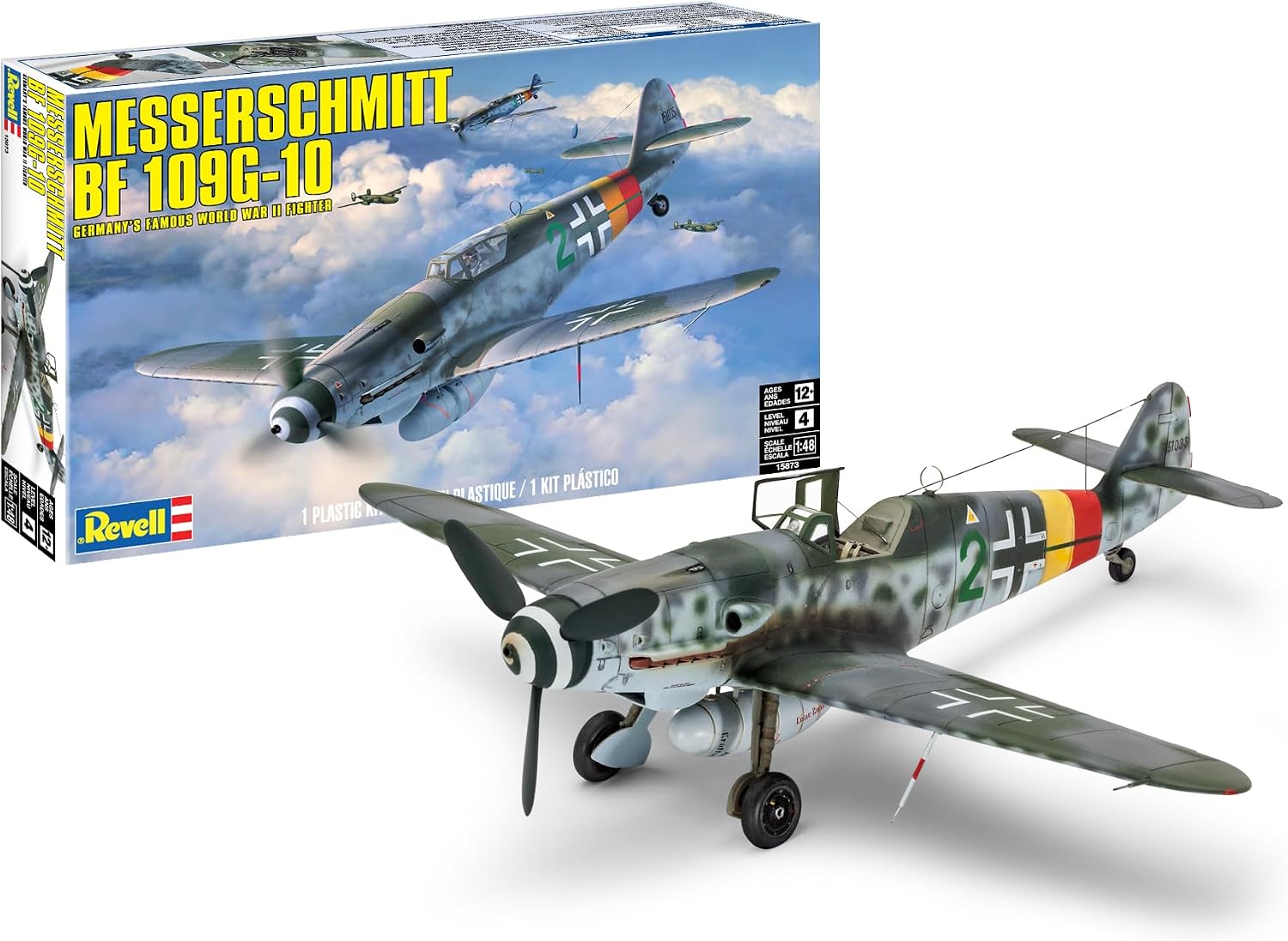
Best Step Up for Aircraft Builders: Revell Messerschmitt Bf 109G-10 1:48
Revell is hit or miss as a brand. The newer tooling is decent; the old tooling is a test of your patience. What I like about this boxing is that Revell is upfront about the ask: 40 pieces, Skill Level 4. That is the company telling you it expects glue, paint, and decals, not a shake-the-box afternoon.
1:48 is the sweet spot for aircraft. Big enough for cockpit and cowl detail, small enough that you can finish one without a three-month bench commitment. The G-10 is the late-war Gustav, with the larger supercharger intake and the cowl bulges that make the silhouette easy to tell apart from an early 109 at a glance.
A 40-piece parts count is modest for the scale, which usually means a simpler build with fewer tiny subassemblies. Treat the decals like tissue paper: warm water, short soak, no forcing. Test fit the cowl and the wing roots before glue, because those are the two places a small gap turns into a putty job on any 109.
If you have built a few snap-fit kits and want to learn seam filling, masking, and canopy work, this is a reasonable next step. Just go in expecting to test fit everything twice.
The scale and subject reference table
This is the table I keep in my head when someone asks what to build next. Scale first, subject second, brand third.
| Kit | Scale | Subject | What it asks of you | Where to buy |
|---|---|---|---|---|
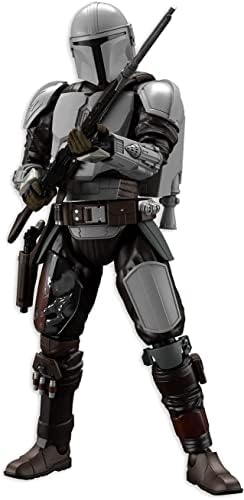 Visit on Amazon → Bandai Star Wars The Mandalorian Beskar Armor |
1/12 | Figure | Snap-fit assembly, panel lining, light weathering | Visit on Amazon → |
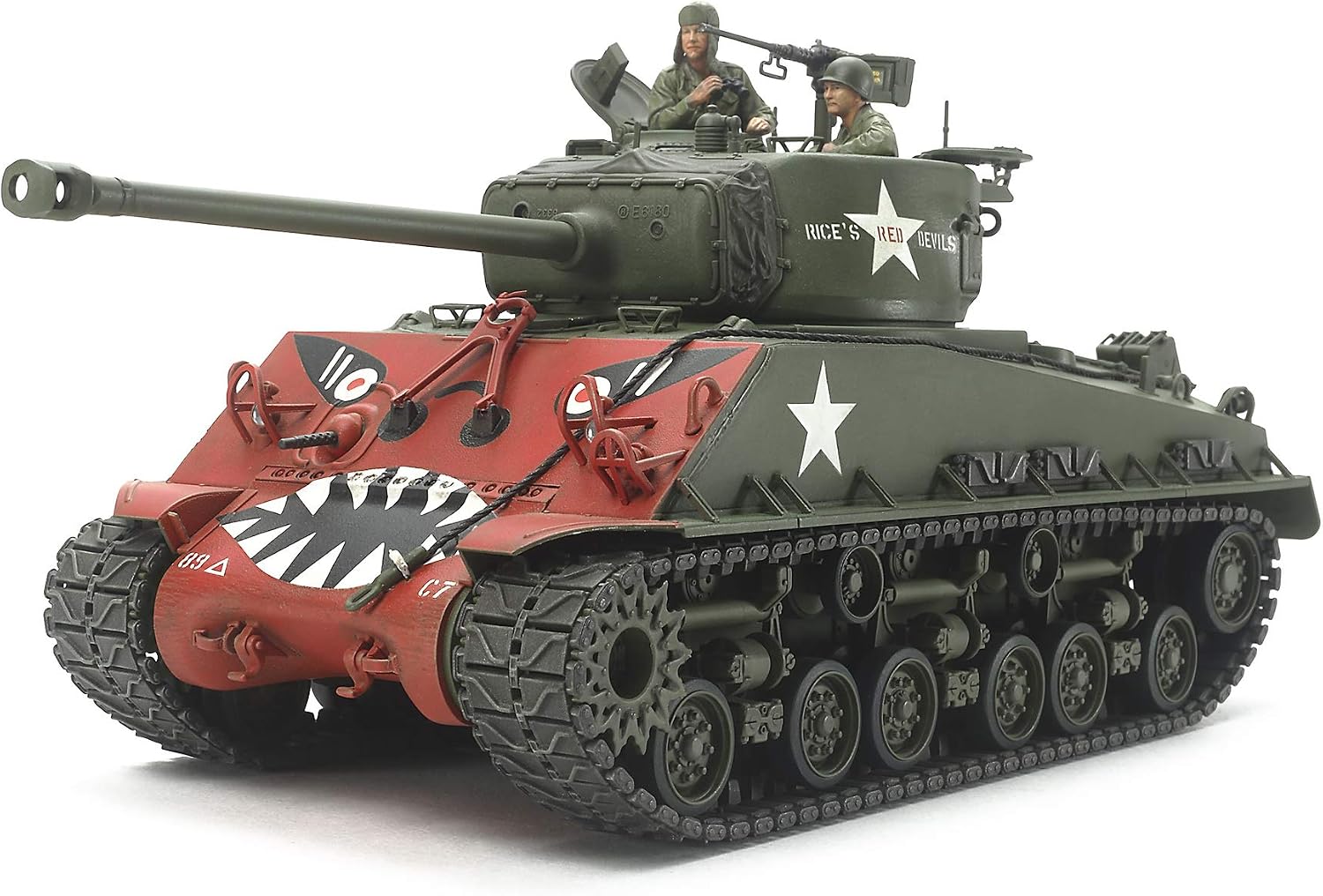 Visit on Amazon → Tamiya M4A3E8 Sherman |
1/35 | Armor | Glue and sanding, weathering practice, clean part fit | Visit on Amazon → |
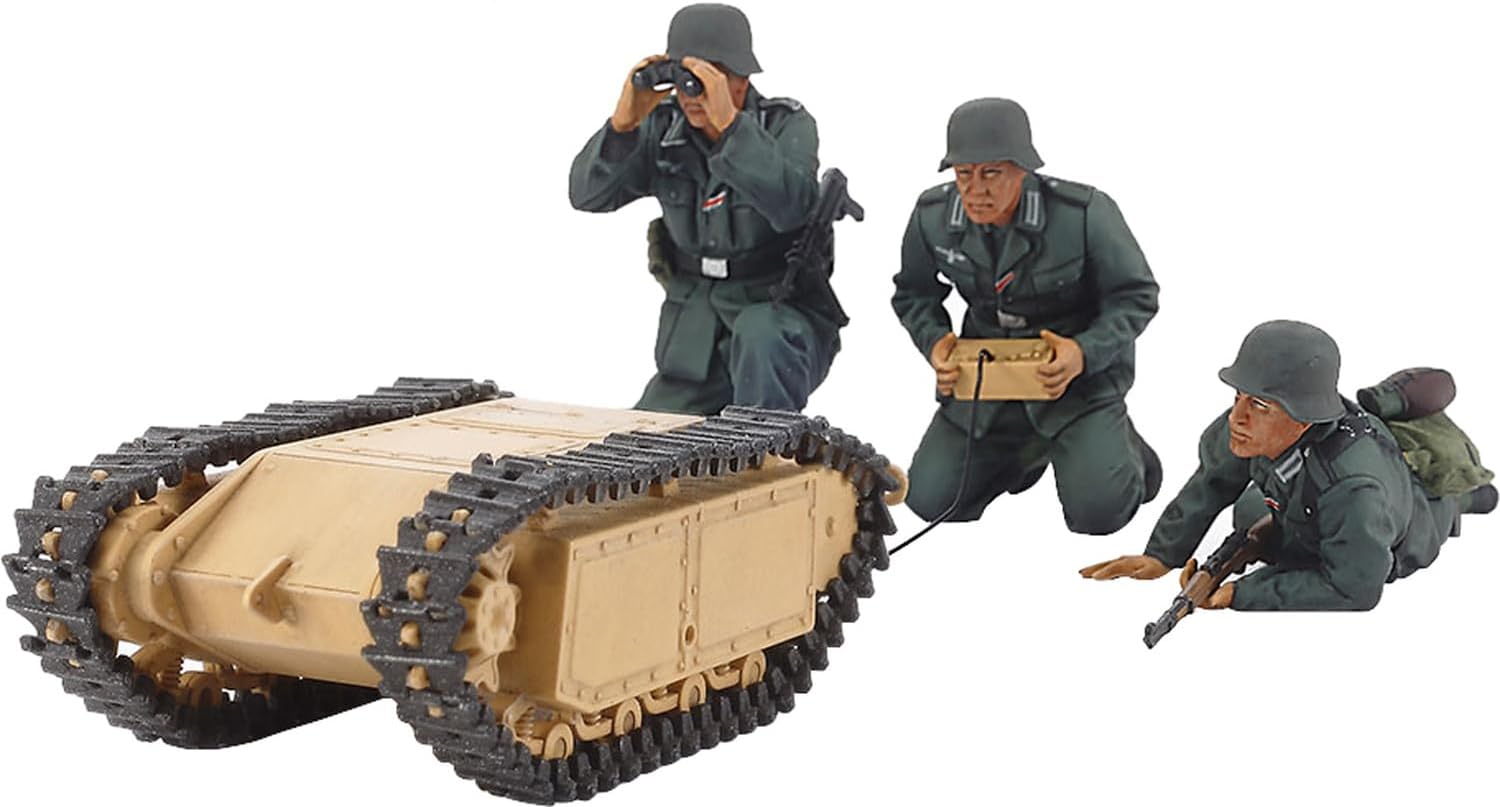 Visit on Amazon → German Assault Pioneer Team with Goliath |
1/35 | Figures and equipment | Figure painting, small equipment, diorama basing | Visit on Amazon → |
 Visit on Amazon → Revell Messerschmitt Bf 109G-10 |
1:48 | Aircraft | Skill Level 4 build, paint and decals, 40 pieces | Visit on Amazon → |
What about other scales?
1/24 and 1/25 for cars, 1/72 for aircraft, 1/144 for the giant Gunpla. Every scale is a trade: bigger means more detail and more shelf, smaller means more kits per shelf and smaller parts. Pick the scale you have room for, then pick the subject you actually want to look at every day.
Do you need an airbrush for any of these?
No. An airbrush is a tool, not a requirement, and at these scales rattle cans and brushes still read well when the surface prep is clean. Spend the money on nippers, sanding sticks, and a decent matte clear coat first. The airbrush can wait until you are tired of masking.
Should you buy the Bandai Star Wars The Mandalorian Beskar Armor 1/12 kit?
Yes, if you want a kit that fits, looks right straight from the box, and gives you a figure big enough to actually enjoy painting. Bandai's snap-fit engineering is the reason this is the safest first build on the list, and the color separation means you are not forced to paint anything you do not want to paint.
The caveat is scope. It is one figure. If you want a vehicle, a base, and a story, this is not that kit. Check current Amazon price before you commit, because Bandai stock moves around.
Should you buy the Tamiya 1/35 M4A3E8 Sherman?
Yes, if you want to learn armor building on a forgiving subject with parts that fit. Tamiya's plastic quality is the reason I keep pointing people here, and the Sherman gives you flat surfaces to practice every weathering technique you have read about.
If you only build snap-fit kits and have no interest in glue and sanding, skip it. This kit is a step, not a side trip.
Should you buy the 1/35 German Assault Pioneer Team with Goliath?
Yes, if you want a diorama. No, if you want a quick win. Figures punish speed, and this set has a whole team plus a tracked demolition vehicle to place. Buy it for the scene, budget twice the time you think you need, and paint a practice figure first.
Should you buy the Revell Messerschmitt Bf 109G-10 1:48?
Yes, with the usual Revell caveat: judge the boxing, not the logo. Skill Level 4 and 40 pieces tell you exactly what the build expects, and 1:48 is the scale where aircraft look right on a normal shelf. If you want a first aircraft with no surprises, look for a newer tooling. If you want a late-war Gustav and you are willing to test fit, this one earns its spot.
The short version
Pick the scale you have room for. Then pick the subject you will still like in three months. Bandai's 1/12 Mandalorian is the cleanest build of the four, Tamiya's Sherman is the best value for learning armor, the German pioneer team is the best diorama project, and the Revell 109 is the step up for anyone who wants wings. Check current Amazon price on each before you buy, and keep a sanding stick within reach.