I built my first kit at 11 on a kitchen table with borrowed nippers and no idea what a nub was. Fifteen years and a backlog that will outlive me later, I still judge every purchase the same way: does it fit without glue, where are the gates, and would I build it again for fun. So when four items land on the same list and they turn out to be a Bandai Star Wars kit, a kid's airplane toy, a paint brush, and a ship-modeling book, I do not roll my eyes. I recognize it. That is what a first bench actually looks like before anyone tells you what to buy.
This is a comparison of model kit starter picks, not a ranking of four things that do the same job. They do not. One is engineering, one is a toy, one is a consumable, and one is a teacher. The useful question is which one your money should go to first, and the honest answer depends on whether you are buying for yourself or for a nine year old.
The best model kit starter pick for most people here is the Bandai Trench Run Set, because Bandai's snap-fit engineering means no glue, no putty, and a finished object on the shelf the same weekend. But a bench needs three of these four eventually, and the fourth is the one you buy when the first three stop being enough.
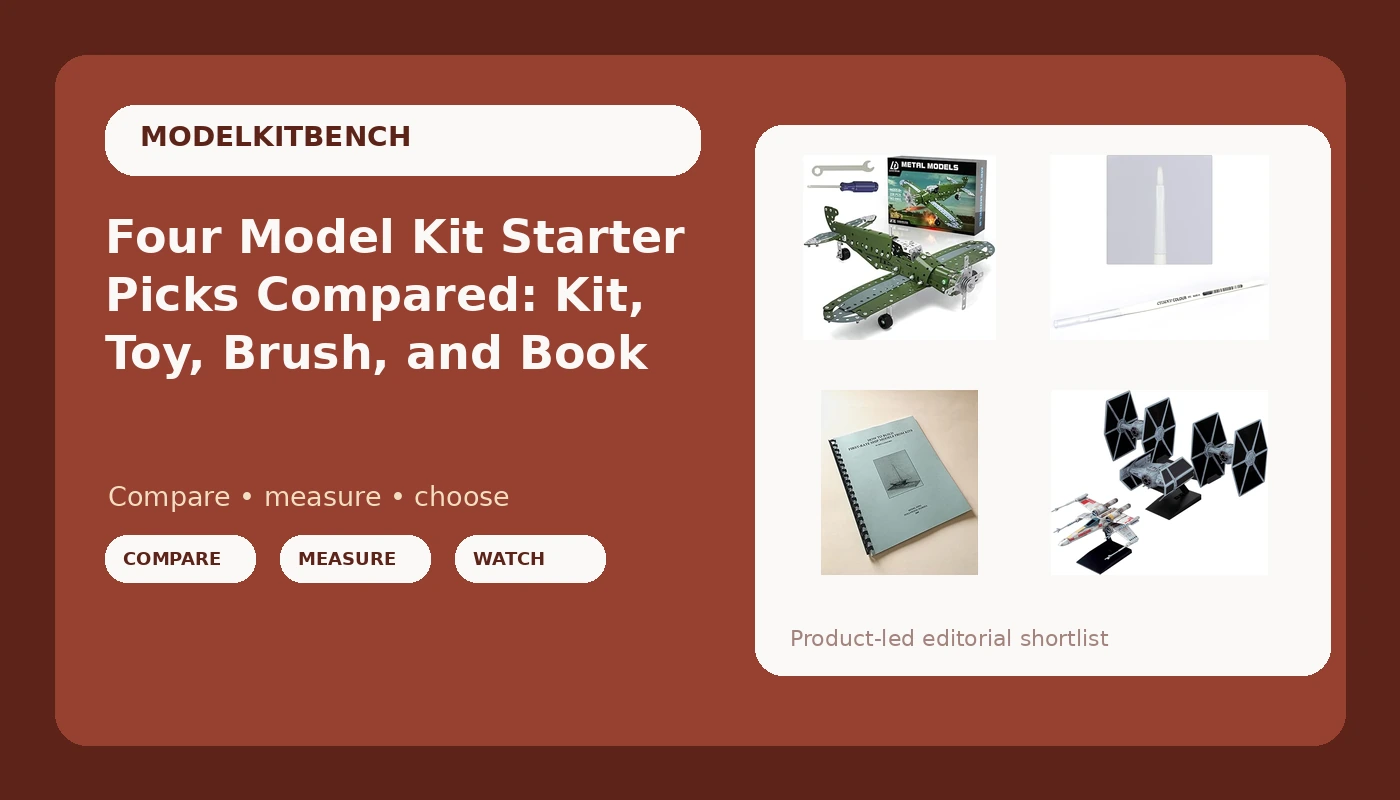
Bandai Hobby - Star Wars: A New Hope - #20 Trench Run Set Vehicle Model Kit
Real Bandai tooling: snap-fit joints, color-separated plastic, no glue required
Small parts, short build, and the finish is entirely on you
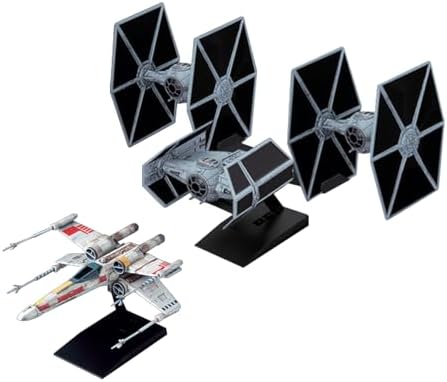
Lucky Doug Building Toys Model Airplane Set - DIY Building Stem Projects Toys for Kids Boys Ages 8-12, Assembly Science Toys for Model Fans
The cheapest on-ramp for a kid aged 8 to 12, playable after the build
A toy, not a scale kit: no decals, no panel lines, no accuracy to chase
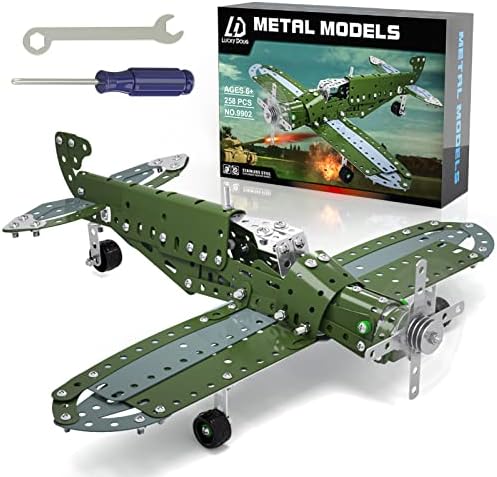
CITADEL Warhammer: Synthetic Base Brush Medium
The base-coat workhorse, springy synthetic bristles that survive acrylics
Not a detail brush, and synthetic tips soften long before a good sable does
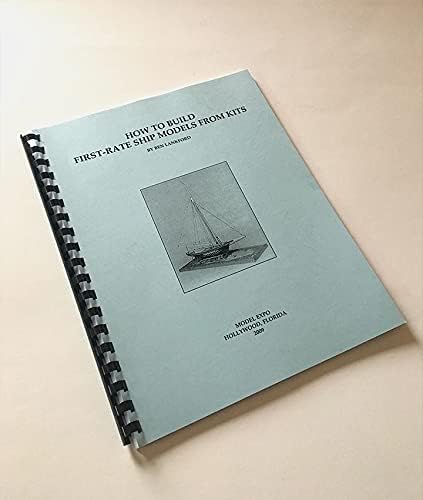
Model Shipways How to Build First Rate Ship Models from Kits
Teaches planking, rigging, and wooden-hull discipline that no plastic kit forces
A book: no parts, no plastic, nothing to put on the shelf
Prices and availability were captured from Amazon Creators API and may change.
These four are not the same kind of product
A comparison only works if you are honest about categories. Two of these are build projects, one is a tool you use on build projects, and one is a reference that teaches a completely different branch of the hobby. Putting them in one table is useful for budgeting. It is not useful for crowning a winner.
I also want to be straight about what I have and have not done. I have not run a full build on the Bandai Trench Run Set, and I have not assembled the Lucky Doug airplane. I know Bandai's house style from years of their kits: snap-fit joints, color-separated runners, gates tucked under the part instead of on the visible face. I know what synthetic brushes do to a base coat because I have ruined enough of them. I know what a ship-modeling book is for because I have stared at a wooden hull and closed the tab. Where I am working from the category rather than the specific box, I will say so. That is the standard I hold every review to, so it would be strange to abandon it here.
The kit: Bandai Trench Run Set
Bandai Hobby's Star Wars line is where a lot of people discover that a licensed kit can still be engineered well. The Trench Run Set is a vehicle kit, which means no inner frame to marvel at and no figure to pose. What you get is small-scale ships and a scene, at the scale Bandai does well.
The reason I would hand this to a new builder before almost anything else on this list is fit. Bandai's tooling is the closest thing the hobby has to a guarantee: parts key together, gates sit under the part rather than on the face you will look at, and the plastic is molded in colors close enough to look finished without a drop of paint. You still have to cut clean and sand nubs. You always have to. But you are not fighting the kit while you learn.
Where it loses: small parts, a short build, and a finish that is entirely on you. A trench run scene without weathering looks like a toy, and weathering is a skill you have to build separately. Decals will not rescue a flat surface, and a kit this size does not leave much room for a long project. You buy this one to learn clean assembly, then to learn paint on.
The toy: Lucky Doug airplane set
The Lucky Doug set is honest about what it is right in the name: building toys, DIY, STEM, ages 8 to 12. That is not a scale model and it is not pretending to be. It is an assembly project that ends with something a kid can hold up and then actually play with, which is a different goal from a shelf piece.
If you are buying for a child who has never built anything, this is a reasonable first contact with the idea of following a manual and connecting parts in order. The trade-off is that almost none of the skills transfer cleanly. There are no nubs to sand in the way a modeler means it, no panel lines, no decals, no color callouts, no accuracy to chase. A kid who loves this may or may not want the harder version of the hobby later.
My rule for beginners applies to kids too: start where the kit does not punish you. This set does not punish anyone. That is its whole value, and it is also its whole ceiling.
The tool: Citadel Synthetic Base Brush Medium
Nobody budgets for the brush. Then they buy a kit, buy paint, and try to base coat a model with whatever came in a cheap set, and the result looks like it was applied with a spatula.
A medium base brush is the workhorse size. It covers large flat areas without leaving streaks, and synthetic bristles are the right material for that job: springy enough to push paint around, tolerant of acrylics, and cheap enough that you are not afraid to use it. The Citadel synthetic line is built for exactly this kind of work. It is not a detail brush. If you are painting an eye or a tiny cockpit console, you want a smaller tip, and probably a sable one.
Where it loses: synthetic tips soften. That is not a defect, it is the material. A good sable brush keeps a point far longer and costs several times as much. For base coats and washes, synthetic is the sensible buy. For the last 10 percent of a build, it is not.
And if you build straight out of the box and never paint, skip this entirely. No brush improves a kit you are not painting.
The book: Model Shipways How to Build First Rate Ship Models from Kits
This is the odd one out, and the most interesting one if you have been building plastic for a while. Wooden ship modeling has no snap-fit. There are no under-gates. There is planking, there is rigging, and there is a hull that will tell the truth about your patience. A book on building first rate ship models from kits is a technique manual for a branch of the hobby most plastic builders never touch.
The trade-off is obvious: it is a book. There are no parts in the box. It will not teach you to fix a seam line on a Gundam, and if plastic is all you ever build, this sits on a shelf and gathers dust.
What it will do is change how you think about the parts of the hobby that plastic hides from you. Planking teaches you to work in sequence and to accept that the first pass is rough. Rigging teaches tension and planning. If you have ever looked at a wooden ship kit, felt something, and closed the tab, this is the book that makes you reopen it. If you have never felt that, buy the Bandai kit instead and come back in two years.
The order I would buy them in
Kit first, always. You cannot learn anything from tools you have no reason to use. The Bandai set is the one that puts a finished object on the shelf and teaches clean cutting, sanding, and assembly along the way.
Brush second, but only if you intend to paint. If your plan is to build snap-fit kits in molded color, the brush waits.
Book third, and only once you have hit a wall a plastic kit cannot teach you past. The wall usually sounds like "I want to do something that has no gates."
The Lucky Doug set is not fourth in that order. It is parallel. It is for a kid, or for a parent and a kid on a rainy Saturday, and it does not belong in a progression toward competition building. It belongs in a different conversation.
Where each one actually loses
Every product in this list has a real failure mode, and I would rather you hear it now than after the box is open.
The Bandai kit loses on scope. Small vehicles, a short build, and a finish that needs paint and weathering to look like the box art. You will be done in a weekend and then you will want another kit.
The Lucky Doug set loses on transfer. It is a good toy and a poor apprenticeship. Expect fun, not skill.
The Citadel brush loses at the tip. Buy it for base coats, replace it when it stops pointing, and do not ask it to be a detail brush.
The Model Shipways book loses on immediacy. It solves problems you do not have yet, and it assumes you are willing to buy into a branch of the hobby that takes months per project.
The fit question, applied to all four
My whole standard for a kit is whether it holds together without glue and whether the engineering hides its own seams. Applied to this list:
The Bandai kit is the only one where fit is even a category. Bandai earns that reputation kit after kit, which is why it gets the recommendation.
The Lucky Doug set is judged differently. Does it stay together under a kid's hands? That is the only fit question a toy has to answer.
The brush is judged by its tip. A brush that splays after a month of base coating failed, no matter what the label promised.
The book is judged by whether it answers the question you actually had. A technique manual that is beautiful and unhelpful is worse than a plain one that solves your problem. That is the standard I will hold it to if it ends up on my bench.
What is on my bench next
I am mid-way through this year's RG releases, three kits, a part-fit scorecard each, and a verdict on whether the detail is worth the fragility. That is where my time goes, and it is why I care about the boring parts of this list: a clean cut, a brush that still points, and a reference that tells you the truth about a hull.
None of the four items here is a competition build. That is the point. A first bench is not a statement, it is a place to make mistakes cheaply. Buy the kit that fits, add the tool when you need it, and keep the book for the day you want the hobby to get bigger.