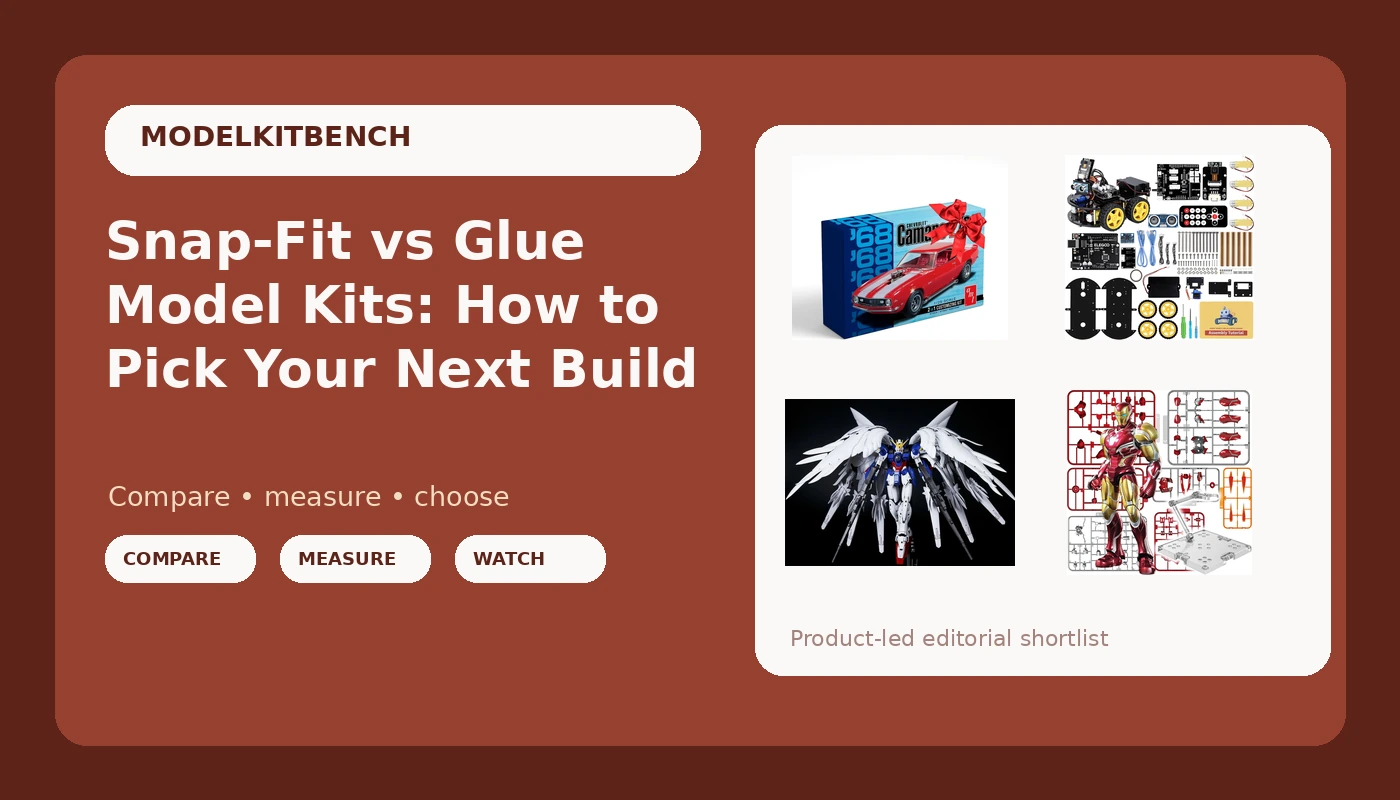
Most people who ask me what to build next are really asking a different question: how much work do I want to sign up for? The hobby splits into two broad families, and the line between snap-fit vs glue model kits decides your tool list, your weekend, and how the finished thing holds up on a shelf. A snap-fit kit clicks together off the runner and can be built at a kitchen table with a pair of nippers. A glue kit asks for cement, sanding, and usually paint. Between those two poles sit programmable robot kits with circuit boards, no-tools figure kits built for older kids, and detail sets designed to upgrade a kit you already own. Here are four real options and an honest read on who each one actually suits.
Related: How to Read a Model Kit Sprue Before You Buy →
Quick answer
Pick by workflow, not by subject matter. If you want to assemble and display with no cement and no paint, a snap-fit kit is the right lane, and the BLOKEES Iron Man is a clean example of that approach. If you want the traditional hobby experience with cement, sanding, and paint, a 1:25 scale car kit is the classic route. If you want the finished build to do something after it is done, an Arduino-compatible robot kit adds code and sensors to the assembly. If you already own a specific Gundam kit and want to push its detail further, a companion set made for that exact kit is the move. None of these is universally best; they are four different kinds of project, and pricing on all of them moves, so check the listing before you commit.
Four useful options
| Model | Best fit | What stands out |
|---|---|---|
| AMT 1968 Chevy Camaro Z/28 1:25 Scale Model Kit | Builders who want a classic cement-and-paint automotive project | A 1:25 scale 1968 Camaro Z/28 subject in the traditional glue-and-paint tradition |
| ELEGOO UNO R3 Smart Robot Car Kit V4 with Camera, Compatible with Arduino | Builders who want electronics and code alongside assembly | An Arduino-compatible UNO R3 board, camera, and robot car chassis in one box |
| BLOKEES - Champion Class Marvel Infinity Saga - Iron Man - 149-Piece Articulated Model Kit | New builders and display-focused buyers who want zero tools | 149 pieces, no tools, no cutting, no glue, no paint, age 14+ |
| DREI Zwerg Kit for MG Wing Zero EW (Ver. Ka) | Gundam builders detailing an existing MG Wing Zero EW Ver. Ka | A companion set made for one specific MG kit rather than a generic accessory |
The classic glue build: AMT 1968 Chevy Camaro Z/28 1:25 Scale Model Kit
Here is the trade-off in plain terms. AMT's 1:25 automotive kits sit in the glue-and-paint tradition, which means you should expect to buy cement, putty, and paint separately, and you should expect to sand. That is not a flaw; it is the point of this category. Cement welds plastic together, which lets you eliminate seams and fix alignment before paint goes down, and a car body gives you a big, smooth surface to practice finish work on. The cost is time and space: you need ventilation, a work surface you can be messy on, and a few evenings rather than one. If your goal is a build you can complete with nippers alone, this is the wrong lane. If your goal is a project that teaches you paint and seam work, a 1:25 scale car is one of the best classrooms in the hobby.
The electronics build: ELEGOO UNO R3 Smart Robot Car Kit V4 with Camera, Compatible with Arduino
This is a different definition of model building. Instead of chasing a seam line, you are mounting a board, wiring motors and sensors, and then uploading code so the thing behaves. That makes it a strong fit for a builder who is curious about electronics, or for a parent looking for a project that spans a weekend and a laptop. The trade-off is that the skill set is broader: you need a computer, you need to be comfortable following wiring instructions, and you need patience with troubleshooting when a motor spins the wrong way. Check the listing for the exact contents and any required tools, because kits in this class vary in what they include. What you get in return is a build that does something: it drives, and with the camera module it can see.
The no-tools starter: BLOKEES - Champion Class Marvel Infinity Saga - Iron Man - 149-Piece Articulated Model Kit - Assembly Required - No Tools - No Cutting - No Glue - No Paint - Age 14+
This is where part fit does all the work. When a kit promises no glue and no tools, the engineering has to carry the entire build, because there is no cement to cover a loose joint and no paint to hide a color break. For a beginner, that is a genuinely low-risk entry point: no nippers, no hobby knife, no fumes, no paint budget. For an experienced builder, the appeal is different, it is a fast, clean build between bigger projects, and the articulation means the finished figure can actually be posed instead of standing at attention. The honest trade-off is subject and scale: this is a figure, not a vehicle or a mobile suit, and the assembly feel of a kit like this differs from polystyrene Gunpla. If you want the traditional plastic-model texture, this is a different experience, not a lesser one.
The detail companion: DREI Zwerg Kit for MG Wing Zero EW (Ver. Ka)
Buying a companion set is a different decision from buying a kit, and it deserves a different checklist. You are not getting a full model here; you are getting parts built around one specific Master Grade release, so the purchase only makes sense if that kit is already on your shelf or on your short list. Before you buy, read the listing carefully to confirm exactly what the set contains, how it attaches, and whether it needs cement, paint, or modification of the base kit. The trade-off is real: companion parts add work, and fit against the original kit is the whole game. The upside is that a good detail set can push a kit you already love into competition territory without starting a new build from scratch. If you are not sure what a set like this includes, ask in a builder community before you order.
Prices and availability may change. Product images, names, and retailer links are matched to verified listings. No current price, rating, stock status, or measured result is stated here without current evidence.
Snap-fit versus glue: what actually changes
The difference is not cosmetic. In a glue kit, cement softens the plastic and welds two parts into one piece. That gives you options: you can weld a seam and sand it flush, you can adjust alignment before the joint sets, and you can fill gaps with putty. It also means the kit can be molded in fewer colors, because the builder is expected to paint. A snap-fit kit has to solve the same problems with geometry instead. Parts are designed with pins, friction fits, and color separation so the model looks right straight off the runner. That is harder engineering, and it is why part fit is the honest measure of a snap-fit kit. If a snap-fit joint is loose, there is no cement to rescue it.
There is a second difference that matters more than people expect: gates. Where the gate attaches determines how much cleanup you face. A well-engineered kit places gates on hidden surfaces or uses under-gates so the nub mark ends up somewhere you will never see. A poorly engineered kit puts gates on visible armor panels and hands you a sanding job you did not ask for. When you evaluate any kit, snap-fit or glue, look at the runner layout before you look at the box art. The box art is marketing. The sprue is the truth.
How to match a project to your bench
- Count your realistic hours first. A single-evening snap-fit build and a multi-weekend paint project are different commitments, and both are fine as long as you pick on purpose.
- Decide what tools you want to own. Nippers alone points to snap-fit. Nippers, cement, putty, sanding sticks, and paint points to a glue kit. A laptop and a screwdriver points to an electronics build.
- Choose a subject you will still care about at hour ten. A kit you love keeps you sanding. A kit you are indifferent to becomes a shelf queen in a box.
- Check the scale against your display space. Scale determines finished size, and a bigger kit is not automatically a better one if it has nowhere to live.
- Decide whether the build should do something. If you want motion, sensors, or code, an electronics kit is the only option on this list that delivers that.
What to check on the listing before you buy
- Confirm the scale and the approximate finished size, especially for automotive and figure kits.
- Confirm what is actually in the box: decals, paint, cement, tools, electronics, and batteries are frequently sold separately.
- For companion and detail sets, confirm the exact base kit the parts are made for, and do not assume compatibility with a similar release.
- Confirm the recommended age and whether any tools are required, since no-tools claims are a selling point worth verifying.
- Read the assembly method in the listing description rather than inferring it from the photo, because product photos are often of a finished, painted build.
- Treat pricing as volatile. Check current Amazon price at the moment you buy rather than relying on a number you saw last month.
Which option should you choose?
Choose the AMT 1968 Chevy Camaro Z/28 1:25 Scale Model Kit when you want the full traditional experience of cement, sanding, and paint, and you have the space and the evenings for it. Choose the ELEGOO UNO R3 Smart Robot Car Kit V4 with Camera, Compatible with Arduino when you want a build that runs code and moves under its own power, and you are ready to troubleshoot wiring. Choose the BLOKEES Champion Class Marvel Infinity Saga Iron Man kit when you want a first build or a gift build with no tools, no glue, and no paint involved. Choose the DREI Zwerg Kit for MG Wing Zero EW (Ver. Ka) when the MG Wing Zero EW Ver. Ka is already in your collection and you want to add detail rather than start something new.
One caveat worth stating plainly: the descriptions above come from the product listings and from how these categories of kit are normally assembled. I have not built these four kits, and no measurements, test results, or ownership claims are being made here. Where the listing is the only source, treat the details as the seller's description and confirm the specifics before you order.
The bottom line
There is no single right answer, only the right match between a kit and the builder holding the nippers. If you want the craft of cement, putty, and paint, the 1:25 scale Camaro is your lane. If you want your build to think and drive, the Arduino-compatible robot car is the one that delivers that. If you want a clean, tool-free afternoon that ends with a posable figure on the shelf, the BLOKEES Iron Man fits that brief. And if you already own the MG Wing Zero EW Ver. Ka, the DREI Zwerg companion set is aimed squarely at you. Pick the workflow you actually enjoy, verify the contents and the current listing details, and the kit you choose will earn its place on the bench.