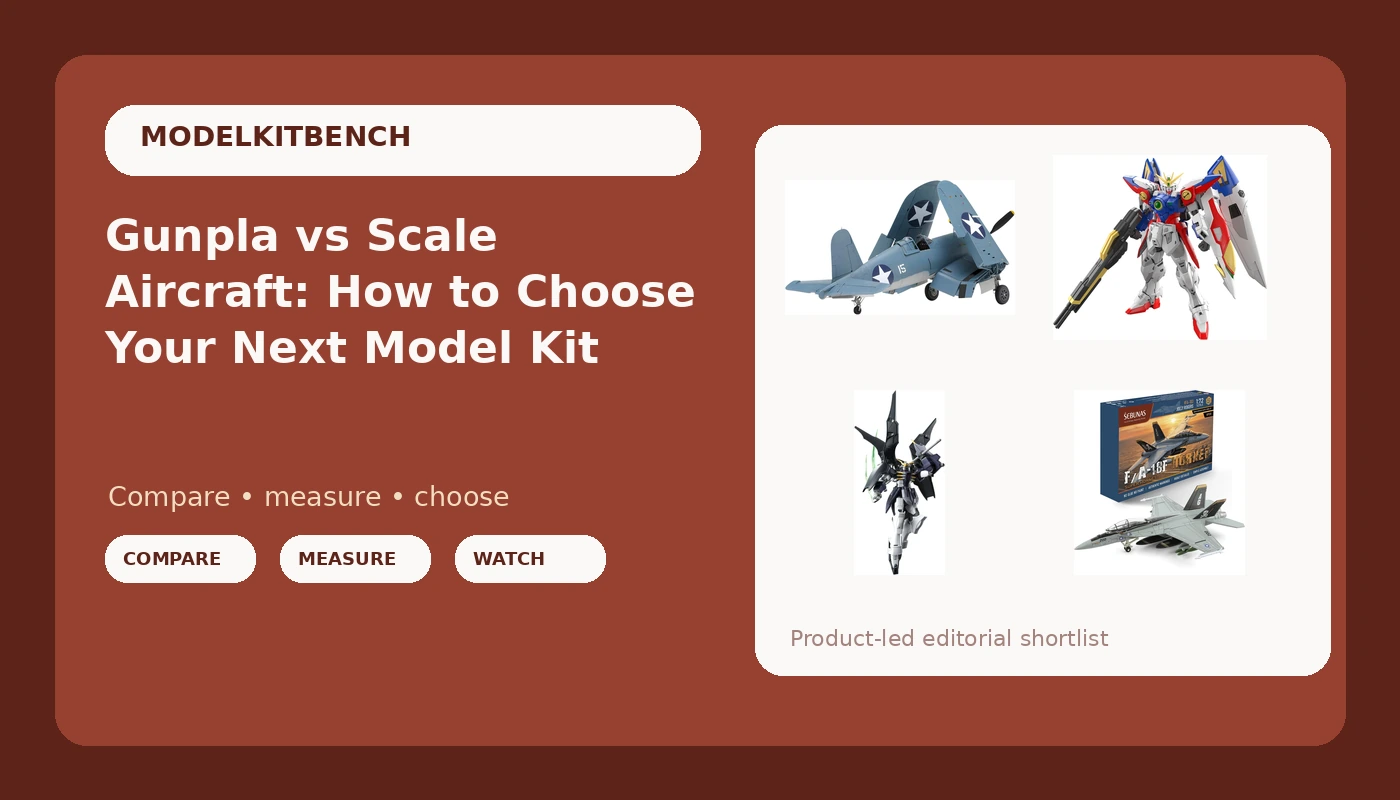
Model kit grades are the biggest source of confusion in this hobby, and the confusion has nothing to do with skill. A 1/144 High Grade Gundam, a Real Grade with an inner frame, a Tamiya aircraft kit, and a 1:72 quick-assembly jet can all sit on the same shelf and ask completely different things of the person building them. Store listings rarely spell out what you are actually buying: how many parts are in the box, whether the kit snaps together or needs cement, how large the finished model will be, and how much cleanup sits between the sprue and the shelf. This explained guide looks at four specific kits, what each one is engineered to do, and how to match one to the bench, the tools, and the time you actually have.
Related: Panel Lining Basics for New Builders →
Quick answer
Pick by build style first, then by subject. Snap-fit Gunpla in 1/144 scale is the most forgiving starting point, because the parts are molded to press together and the color separation is designed into the plastic. Cement-and-paint aircraft kits reward patience and tools, but they require both. If you already love a subject, match the kit's engineering to your available time rather than to the box art, and buy the model you will actually finish.
Four kits, four different jobs
| Model | Best fit | What stands out |
|---|---|---|
| Bandai Hobby - Gundam - Gundam Deathscythe Hell HGAC 1/144 Model Kit | A first snap-fit build | High Grade engineering in 1/144 scale, designed to assemble without cement |
| Bandai Hobby - Gundam Wing - #43 XXXG-00W00 Wing Gundam Zero RG 1/144 Model Kit | Builders who want inner-frame detail | Real Grade part count and color separation packed into 1/144 scale |
| TAMIYA F4U-1 Corsair Birdcage Hobby Model Kit | Painters and scale aircraft fans | Tamiya aircraft tooling, listed for ages 14 and up |
| 1:72 Scale F-18 Jolly Rogers Fighter Jet Quick Assembly Model Kit | A fast, low-stakes build | Quick assembly format with a recognizable Jolly Rogers scheme |
Best first build: Bandai Hobby - Gundam - Gundam Deathscythe Hell HGAC 1/144 Model Kit
What makes a High Grade a High Grade is not the size, it is the engineering budget spent on fit. Modern HG kits are designed so parts seat without force, gates are kept away from visible surfaces where the design allows it, and the runners are molded in the colors the finished kit is supposed to be. The trade-off is scale. At 1/144 a mobile suit is small on the shelf, panel lines are shallower than on a larger kit, and the parts are easy to lose to a carpet. What you get in return is a build you can finish in an evening or two, which matters more than detail when you are learning how plastic behaves.
Step-up detail build: Bandai Hobby - Gundam Wing - #43 XXXG-00W00 Wing Gundam Zero RG 1/144 Model Kit
Real Grade exists to answer a specific question: how much detail can fit into 1/144 scale? The answer is a lot, and the cost is tolerance. RG kits use more parts than an HG of the same subject, and those parts are smaller and fit tighter. That is a feature when you want an inner frame that looks good under armor, and a liability when you are still learning how much pressure a joint can take before it stresses. The honest trade-off is that an RG asks for sharper tools, better lighting, and more patience than an HG, and it will punish a rushed assembly more visibly. If you have built one or two snap-fit kits already, this is the natural next step.
Scale model project: TAMIYA F4U-1 Corsair Birdcage Hobby Model Kit
Tamiya's aircraft line is built around cement, paint, and surface finishing rather than press-fit assembly, and the age rating on this listing reflects that. That is not a warning, it is a description of a different kind of project. An aircraft kit asks you to deal with seam lines, fill gaps, mask a canopy, and decide on a paint scheme before you start. The reward is a model whose final look is almost entirely your work rather than the mold's. If you are not ready to buy cement, putty, masking tape, and paint, this is the wrong first purchase, and a snap-fit kit is the better use of your money until you are.
Quick weekend build: 1:72 Scale F-18 Jolly Rogers Fighter Jet Quick Assembly Model Kit
Quick assembly kits trade part count and fine detail for a build that goes together fast and does not demand a tool bench. At 1:72 a fighter jet is a small model, which makes it a good paint test bed: you can practice a two-tone scheme, try a panel line wash, or experiment with a metallic finish on something you did not spend three weeks on. The trade-off is ceiling. A simpler kit will not hold the same detail as a high-end scale model, so treat it as a warm-up, a gift, or a way to keep your hands moving between bigger projects rather than as the centerpiece of a display shelf.
Prices and availability may change. Product images, names, and retailer links are matched to verified listings. No current price, rating, stock status, or measured result is stated here without current evidence.
What grade and scale actually mean
Grade is a label for a kit line's engineering standard, not a difficulty score. High Grade is Bandai's mainstream line: snap-fit parts, molded color, and a part count aimed at a fast build. Real Grade takes the same scale and adds an inner frame and finer armor separation, which raises the part count and lowers the tolerance for sloppy assembly. Master Grade and Perfect Grade sit above that in size and complexity. None of those labels tells you whether a kit is good. A well-designed High Grade beats a mediocre larger kit every time, because the thing you actually handle is fit.
Scale is a ratio, and it is the number that determines shelf presence. At 1/144 a mobile suit is a small figure you can hold in one hand. At 1:72 a fighter jet lands in roughly the same size range, palm-sized to a little larger depending on the airframe. Aircraft kits in this size band are the classic starter scale for exactly that reason: small enough to finish, large enough to paint without a magnifier.
The third variable is assembly method, and it is the one listings bury. Snap-fit means the parts are molded to press together and hold. Cement kits mean the joints need solvent, which fuses the plastic and lets you fill seams. A kit that says quick assembly is telling you the part count and the fit have been simplified on purpose. Read that as a promise about time, not about quality.
Finishing options matter just as much. Stickers are fast and thick. Waterslides look better and need patience and a setting solution. Dry transfers need burnishing. A kit that includes waterslides is asking for a longer build, and a kit with stickers is telling you the build is meant to be quick.
How to read a kit listing before you buy
- Find the grade or the scale in the title first. HG, RG, MG, and PG tell you the engineering line. 1/144, 1:72, 1/48, and 1/32 tell you the finished size.
- Decide whether you are buying a snap-fit build or a cement build. If the listing does not say, look for the age rating and the tool requirements, and assume cement if the subject is a traditional scale aircraft.
- Check what the kit gives you for finishing: stickers, waterslides, or nothing. That single detail changes the length of the project more than the part count does.
- Estimate the finished size before you commit shelf space. A 1/144 mobile suit and a 1:72 jet are similar footprints, and neither is a centerpiece.
- Match the kit to the time you have this month, not the time you wish you had. An unfinished kit on the shelf is worse than a simple kit you finished.
Practical guidance for your bench
- Buy a decent pair of nippers before you buy a third kit. Flush cutters are the single tool that changes how clean your nubs come out.
- Cut parts from the runner leaving a short stub, then trim the stub with a knife and sand in two or three grits. Cutting flush in one pass stresses the plastic and leaves a white mark.
- Panel line after a gloss coat, not on bare plastic. Ink flows along the recess, and the gloss lets you wipe the excess without staining the surface.
- Topcoat at the end, after decals. A matte or semi-gloss coat unifies the finish and protects waterslides from silvering and peeling.
- Wash resin or heavily handled parts before painting, and keep a small tray for parts you have already cut. Losing a tiny polycap to the floor costs more time than any painting step.
Which option should you choose?
Choose the Bandai Hobby - Gundam - Gundam Deathscythe Hell HGAC 1/144 Model Kit when you want a snap-fit build you can finish in an evening without buying cement, paint, or a full tool kit. Choose the Bandai Hobby - Gundam Wing - #43 XXXG-00W00 Wing Gundam Zero RG 1/144 Model Kit when you have a couple of snap-fit builds behind you and want inner-frame detail in the same small scale. Choose the TAMIYA F4U-1 Corsair Birdcage Hobby Model Kit when you are ready for a cement-and-paint project and want the finish, not the assembly, to be the point. Choose the 1:72 Scale F-18 Jolly Rogers Fighter Jet Quick Assembly Model Kit when you want a fast, low-stakes build to test a paint scheme or to keep momentum between bigger projects.
None of these listings states a part count, a finished dimension, or the exact contents of the decal sheet in a way that can be confirmed from the title alone, so treat grade and scale labels as a starting point and check the listing details before you buy. No current price, rating, or stock status is stated here.
The bottom line
Grade and scale are labels for engineering and size, and neither one tells you whether a kit is right for you. The Deathscythe Hell is the snap-fit entry point. The Wing Gundam Zero RG is the detail step up at the same 1/144 footprint. The Tamiya Corsair is the cement-and-paint project that rewards tools and patience. The 1:72 F-18 is the fast build that keeps your hands moving. Pick the one whose build style matches the time and tools you have right now, and the kit you finish will always beat the kit you meant to finish.