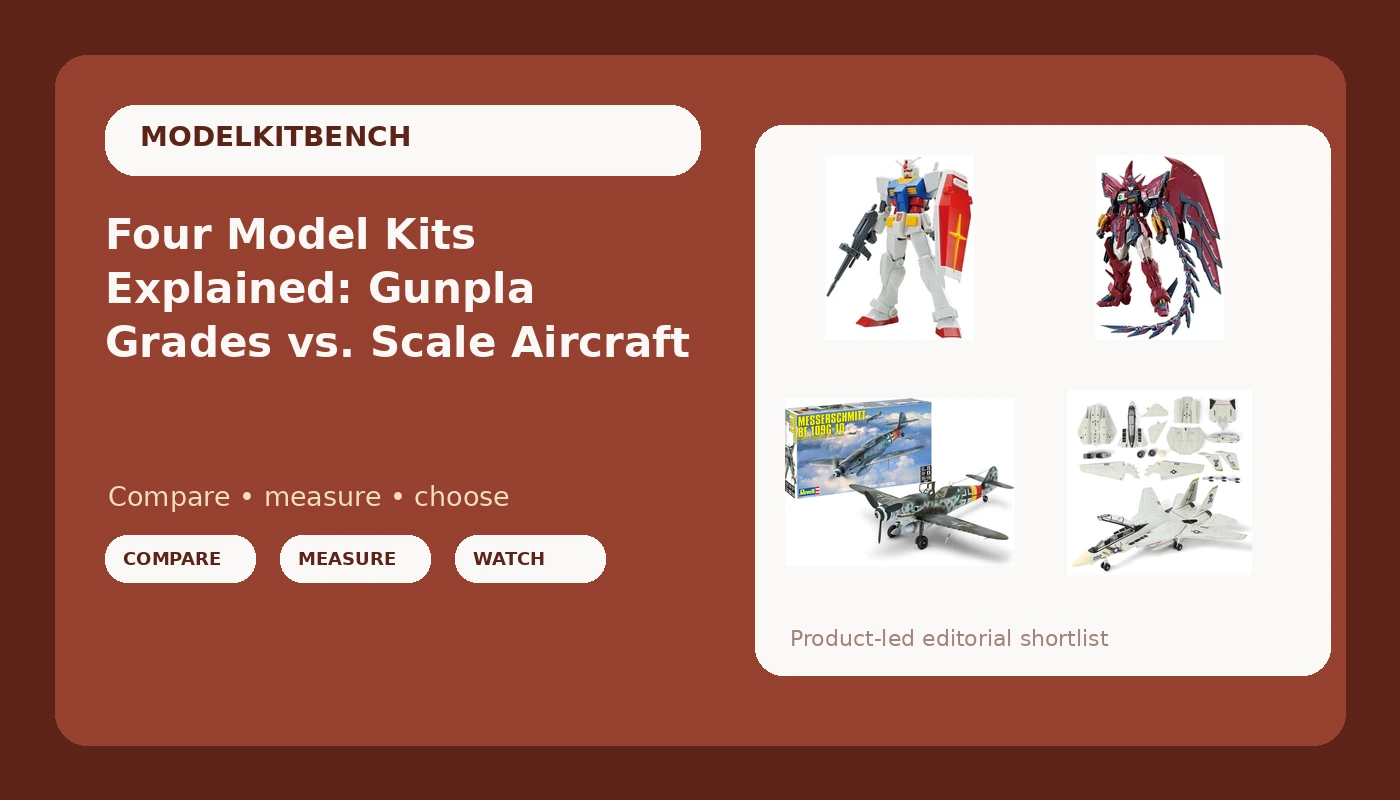
Most people shopping for a first model kit hit the same wall. The boxes all look great, the labels all sound impressive, and nothing on the shelf tells you which kit will actually be fun to build on a kitchen table. Getting model kit grades explained in plain terms solves most of that confusion. The letters and numbers on a box, whether that is EG, HG, RG, or a Revell skill level, describe how the kit goes together, how many parts you handle, and how much finishing work it expects from you. This guide uses four currently listed kits to show what those labels mean in practice, so you can match a box to your bench, your tools, and your patience.
Related: How to Sand Nubs Without Scuffing the Plastic →
Quick answer
If you have never built anything, start with the Bandai Spirits Entry Grade 1/144 RX-78-2 Gundam, because the Entry Grade line is positioned as the simplest snap-fit way into the hobby. If you want a military subject and already own nippers, the Revell Messerschmitt BF 109G-10 is a 1:48 scale, 40-piece Skill Level 4 project. If detail and inner-frame engineering are what pull you in, the Real Grade 1/144 Gundam Epyon is the most involved build of the four. If you want something a child or a total first-timer can finish quickly, the SEBUNAS 1:72 F-14 Tomcat is the low-commitment option. The labels on the box, not the box art, are what tell you which of those four you are actually buying.
Four useful options
| Model | Best fit | What stands out |
|---|---|---|
| Bandai Spirits Entry Grade 1/144 RX-78-2 Gundam | A first build with minimal tools | Entry Grade line, 1/144 scale, snap-fit design |
| Revell Messerschmitt BF 109G-10 | A military aircraft project with finishing work | 1:48 scale, 40 pieces, Skill Level 4 |
| Bandai Spirits RG 1/144 Gundam Epyon | Builders chasing detail and frame engineering | Real Grade line, 1/144 scale, Gundam Wing subject |
| SEBUNAS 1:72 F-14 Tomcat | A fast, low-commitment afternoon build | 1:72 scale, 3D quick build format |
First kit: Bandai Hobby - Mobile Suit Gundam - 1/144 RX-78-2 Gundam, Bandai Spirits Entry Grade Model Kit
The trade-off here is detail, and it is a deliberate one. Entry Grade kits are engineered around a short parts count and a forgiving assembly order, so you get less surface detail and fewer color-separated panels than a Real Grade or Master Grade release would give you. That is exactly what makes it a good first box. You learn where gates sit, what a nub feels like under a fingernail, and how much pressure a joint takes before it complains, all on a kit that does not punish a mistake. If your goal is a shelf piece that rewards an airbrush and weeks of evenings, this is not that kit. If your goal is to find out whether you enjoy the hobby at all, it is the cheapest way to answer the question.
Scale aircraft project: Revell 15873 Messerschmitt BF 109G-10 1:48 Scale 40-Piece Skill Level 4 Model Airplane Building Kit
This is the kit in the group that behaves least like a Gunpla. Revell's skill scale runs from 1 to 5, and a level 4 rating signals a build that assumes cement, paint, and finishing work rather than a bag of pre-colored parts that click together. A 1:48 fighter is also a different kind of object on the bench: you are dealing with a fuselage seam, a canopy, and a paint scheme, and those are the skills the military side of the hobby is actually about. It is a fair second or third kit, not a first one. If you have never held a tube of model cement, buy the Entry Grade first and come back to this one when a visible seam line bothers you enough to do something about it.
Detail-focused build: Bandai Hobby - Gundam Wing - #38 Gundam Epyon, Bandai Spirits RG 1/144 Model Kit
Real Grade is where Bandai packs the most internal structure into the smallest shell. The whole premise of the grade is that a 1/144 kit gets an inner frame and panel separation closer to what you would expect from a much larger release. That is genuinely impressive engineering and it is also the reason RG kits have a reputation for being less forgiving in the hands of a beginner: more parts means more small parts, and small parts mean more chances to lose one to the carpet. The Epyon is a good pick if you already know how to clean a nub without gouging the plastic and you want a build that keeps you busy for several sessions. If you are still learning where to cut, buy the Entry Grade and save this one for later.
Quick build: SEBUNAS 1:72 F-14 Tomcat 3D Quick Build Model Kit Fighter Jet Aircraft
Quick build kits are their own thing, and judging them against a Real Grade is a category error. The format exists for people who want a finished object in an afternoon, including kids, gift recipients, and adults who like the subject more than they like the process. You give up part count, surface detail, and the deep satisfaction of a multi-week build. You gain a kit that does not require a paint shelf, a cement bottle, or a dedicated workspace. If you are buying for a child or for someone who has never shown interest in modeling, this is the low-risk entry. If you are buying for yourself and you already own nippers, you will finish it in one sitting and immediately want something with more meat on it.
Prices and availability may change. Product images, names, and retailer links are matched to verified listings. No current price, rating, stock status, or measured result is stated here without current evidence.
What the grade and skill level labels actually mean
Gunpla grades are a ladder, and each rung answers a different question. Entry Grade is the simplest: short parts count, snap-fit assembly, no paint or glue needed to get a finished-looking robot. High Grade is the volume tier, with a huge catalog and a wide range of part counts. Real Grade takes 1/144 scale and adds an inner frame and finer detail, which is why RG kits have more parts and more fragile small pieces than the same subject in High Grade. Master Grade moves up to roughly 1/100 scale with more parts and more color separation, and Perfect Grade sits at the top with the largest size and the highest part counts. None of those labels is a quality ranking. A well-engineered High Grade can be a better build than a mediocre release in a higher grade, and anyone who has built a few kits has a story about exactly that.
Scale is the other number you need to read, and it works backwards from intuition. In 1/144, the model is 144 times smaller than the real machine. In 1:72 and 1:48, the model is 72 or 48 times smaller. That means a smaller second number gives you a bigger model: a 1:48 fighter is larger than the same aircraft at 1:72. Scale tells you shelf footprint and how much detail the kit can physically hold, nothing more.
Revell's skill levels work differently from Gunpla grades. They describe expected process rather than part engineering. A low level points toward snap assembly and pre-colored parts, while higher levels assume cement, paint, and finishing work. A Skill Level 4 aircraft is telling you to expect a glue build with a paint plan, which is a very different evening from clipping out a snap-fit robot.
Five questions to ask before you buy
- Have I built anything before? If the answer is no, start in the simplest tier available for the subject you like, and accept a smaller kit as the price of learning.
- Does the box say snap-fit or does it say skill level? Snap-fit means the parts are engineered to hold without cement. A skill level rating is a signal that cement and paint are part of the plan.
- What scale fits my shelf and my hands? A 1:72 aircraft is small and quick; a 1/144 Gundam is roughly palm-sized; a 1:48 fighter takes real shelf space.
- Do I own the tools the kit assumes? Nippers and a sanding stick cover most snap-fit builds. Cement, paint, and masking supplies are a separate budget line for a glue kit.
- Is the subject something I actually like? The best-engineered kit in the world sits half-built if you do not care about the machine.
What to have on the bench before you start
- A pair of hobby nippers. Cutting parts off the runner with household scissors damages the plastic and flattens the nub.
- A sanding stick or fine-grit sandpaper for cleaning nubs down to the surface.
- A hobby knife for trimming flash and tight gate marks, used with a fresh blade and a cutting mat.
- A panel line marker if you want the recessed detail to read from across the room; it is the single cheapest upgrade to a finished look.
- A small parts tray or a shallow box lid, because the fastest way to lose a tiny polycap is to knock it off an open table.
- Cement and paint only if the kit calls for them. Snap-fit kits do not need either, and adding glue where the design does not want it causes more problems than it solves.
Which option should you choose?
Choose the Bandai Hobby - Mobile Suit Gundam - 1/144 RX-78-2 Gundam, Bandai Spirits Entry Grade Model Kit when this is your first kit and you want to learn the basics without buying a tool chest. Choose the Revell 15873 Messerschmitt BF 109G-10 1:48 Scale 40-Piece Skill Level 4 Model Airplane Building Kit when you want a military subject and you are ready for cement, paint, and seam work. Choose the Bandai Hobby - Gundam Wing - #38 Gundam Epyon, Bandai Spirits RG 1/144 Model Kit when you already know how to clean a nub and you want the most detailed build in this group. Choose the SEBUNAS 1:72 F-14 Tomcat 3D Quick Build Model Kit Fighter Jet Aircraft when you want a short project, a gift for a younger builder, or a low-risk way to test whether someone enjoys the hobby at all.
This comparison works from the product listings and the published grade and skill level systems rather than from bench testing on these specific kits. Part fit, gate placement, and decal behavior vary from release to release and from runner to runner, and they are the things you only learn with nippers in hand. Treat the labels as a map, not a guarantee, and let the first kit teach you what the second one should be.
The bottom line
Grade and skill level labels are the only honest guide you get before you open the box, and they are enough to sort four kits into four different buyers. The Entry Grade RX-78-2 is the on-ramp. The Revell Messerschmitt is the glue-and-paint project. The Real Grade Epyon is the detail build that rewards experience. The SEBUNAS Tomcat is the quick, low-commitment one. Pick the label that matches where you actually are in the hobby, not the box art that looks the most impressive on the shelf.