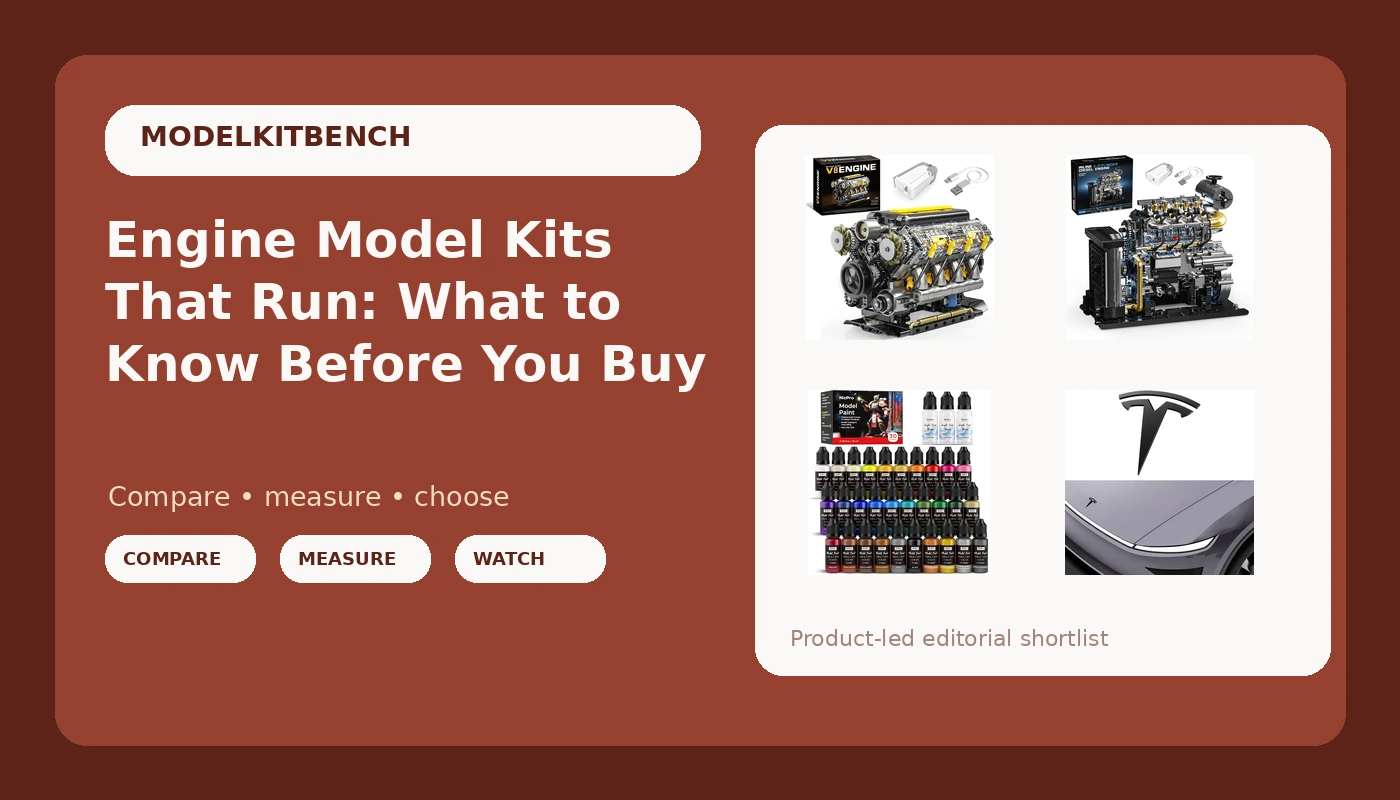
Engine model kits that run sit in an odd corner of the hobby. They look like building sets, they get sold as STEM toys, and they end up on the same shelf as your Gunpla and your Tamiya kits. The problem is that most buying pages give you a piece count and nothing else, so you are left guessing whether a motorized engine is a weekend build or a month of frustration, whether the plastic is going to fight you, and whether you need paint at all.
This is an explainer, not a scorecard. I am not going to pretend I built all four of these on my bench and timed them. What I can do is walk through what each listing actually describes, where the categories overlap, and how to decide which one belongs on your table.
Related: Model Kit Tools for Beginners →
Quick answer
If you want a first motorized engine build, the V8 kit at 905 pieces is the more forgiving starting point. If you want a longer build with a different mechanical layout, the inline 4-cylinder diesel at 1029 pieces is the step up. The Nicpro paint set covers the finishing step most engine kits leave to you, and the Spigen emblem belongs to the full-size car in your driveway rather than the shelf.
Four useful options
| Model | Best fit | What stands out |
|---|---|---|
| V8 Engine Model Kit that Runs (905 PCS) | A first motorized engine build | 905 pieces, listed as compatible with Lego-style bricks |
| Diesel Engine Model Kit that Runs (1029 PCS) | Builders who want a longer, more detailed assembly | Inline 4-cylinder layout, 1029 pieces, listing specifies a motor |
| Nicpro 30 Colors Model Paint Set | Finishing an engine or any other kit | 30 colors in 20ml bottles, described as ready to use |
| Spigen Front Emblem Hood Ornament | The full-size car, not the shelf | Listed for Tesla Model Y Juniper and Model Y L |
The starter build: V8 Engine Model Kit that Runs, Visible Mini Car Motor Building Blocks Set for Adults, Compatible with Lego, STEM Physical Science Educational Toy for Teens Boys 14+ (905 PCS)
The reason to start here is not that 905 pieces is small. It is not. The reason is that a V block gives you two banks of moving parts to watch at once, and the motion is easy to follow with your eye. On a running engine kit, that visual feedback is the whole payoff. You can see whether a part is seated correctly because the mechanism either turns smoothly or it does not.
One thing to settle before you order: the listing is not a statement about batteries, tools, or a display stand. Check the product page for what is actually in the box, because "runs" listings vary on that.
The step up: Diesel Engine Model Kit that Runs for Adults, MOC Mini Inline 4-Cylinder Diesel Engine Building Set with Motor, Compatible with Lego, Mechanical Engineering STEM Toy for Teens (1029 PCS)
More pieces means more steps, and more steps means more chances to seat something backwards early and only discover it three subassemblies later. That is the real difference between a 905-piece and a 1029-piece engine, not the number itself. Longer builds are also where a part-fit habit pays off. If a connection needs force, stop and look at it, because forcing a brick is how you crack a plate and stall the build for a week.
The listing naming a motor directly is worth flagging. Some "that runs" products are vague about how the motion happens, and you should read the page carefully to confirm what is included.
The paint station: Nicpro 30 Colors Model Paint Set, 20ml Ready to Use Modeling Acrylic Paints
Painting a running engine kit is a decision, not an obligation. If the parts move against each other, paint in the contact points adds thickness, and thickness turns a smooth crank into a sticky one. The practical approach is to paint the parts that do not move and leave the bearing surfaces bare. That is where a set like this helps: you are not chasing a specific color match, you are giving a block of grey plastic some depth.
Ready-to-use acrylics also mean a shorter setup. Squeeze, brush, rinse the brush in water, move on. No thinner, no mixing cup, no waiting on a formula you got wrong.
The real-car detail: Spigen Front Emblem Hood Ornament for Tesla Model Y Juniper & Model Y L
If you build a model of a machine, you tend to notice the real one more. That is the only bridge between this emblem and the engine kits above. It is a small cosmetic part for a specific vehicle, and the decision process is completely different from picking a kit: there is no piece count, no part fit, no seam lines. There is just fitment, and fitment is binary. Either it is listed for your variant or it is not.
Prices and availability may change. Product images, names, and retailer links are matched to verified listings. No current price, rating, stock status, or measured result is stated here without current evidence.
What "runs" actually means on a model engine listing
A running model engine is not an engine. There is no combustion, no fuel, and no exhaust. What the word "runs" describes is a small electric motor driving a mechanism, usually a crank and a set of pistons, so the finished model moves the way the real thing does. That is the entire trick, and it is a good trick. Watching a crank turn and pistons rise and fall is what separates these kits from a static display model.
The engineering question is how that motion is transferred. The cleanest designs use a motor with a reduction gear driving a crank, so the moving parts travel at a believable speed rather than spinning like a food processor. The failure mode is a mechanism that binds: one slightly misaligned part adds friction, the motor strains, and the whole thing stutters or stalls. That is why part fit matters more on a running kit than on a static one. On a static model a tight joint is invisible. On a moving model it is audible.
This is also why you should read the listing rather than the box. Some running kits ship with the motor and the wiring; some expect you to supply batteries; some are sold as display pieces with a hand-cranked mechanism. The names tell you part of the story, and the product page tells you the rest. Before you order, confirm three things: what powers it, what is included, and whether the mechanism is meant to be operated or just posed.
One more habit from building scale models applies here. Test the mechanism before you close it up. If the crank turns freely with the housing off and binds with it on, the problem is the housing, not the gearbox, and finding that early saves a full teardown.
Piece count, scale, and what actually slows a build down
Piece count is the number everyone quotes and the number that predicts the least. Two kits with the same count can take wildly different amounts of time, because the real cost is in how many small subassemblies you have to build, check, and set aside before anything visible happens.
The variables that matter more than the total are these. First, color separation: parts molded in the right color save you painting, and a kit with good separation looks finished before you touch a brush. Second, gate placement: on brick-based sets this is less of an issue than on traditional injected kits, but visible connection points still mean cleanup. Third, whether the model is designed to be opened up again. A running engine that is sealed shut after assembly has to be right the first time.
Scale matters too, though engine kits rarely advertise a strict one. What you are really comparing is footprint. A V8 is wide and low; an inline four is tall and narrow. If the finished model is going on a shelf next to your other builds, measure the space before you commit, not after.
And then there is the honest test I apply to every kit: would I build this again for fun? If the answer is no, the piece count was never the problem.
- Decide whether you want a display piece or a working mechanism, because that choice drives everything else.
- Confirm what the listing includes: motor, batteries, tools, and instructions.
- Match the finished footprint to the space you actually have.
- Plan the paint before assembly, and keep it off any surface that has to move.
- Test the mechanism before you close the housing, then test it again after.
Practical guidance for a running engine build
- Keep a parts tray with dividers. A 1000-piece kit with three near-identical small plates will punish you for working off a flat table.
- Sort by step, not by bag. Opening every bag at once feels efficient and almost never is.
- Dry-fit anything that rotates before you commit to it. If it drags now, it will drag louder with the housing on.
- Keep paint out of bearing surfaces. Acrylic is thin, but thin is not zero.
- Photograph each subassembly as you finish it. When step 40 asks you to attach something to a block you built at step 12, the photo is faster than the instructions.
Which option should you choose?
Choose the V8 Engine Model Kit that Runs (905 PCS) when you want your first motorized engine build and a mechanism you can watch without a long runway. Choose the Diesel Engine Model Kit that Runs (1029 PCS) when you have already built something mechanical and you want the inline layout and the extra assembly time. Choose the Nicpro 30 Colors Model Paint Set when you are finishing a kit and want metallics and greys on hand without mixing. Choose the Spigen Front Emblem Hood Ornament when the vehicle you are detailing is the real Tesla Model Y in your driveway.
One caveat on all four: nothing here is a substitute for reading the product page. Motor inclusion, battery requirements, and vehicle fitment are exactly the details that change between variants of the same listing, and those details decide whether a purchase works out.
The bottom line
A running engine model kit is a mechanism first and a model second, and that flips the usual priorities. Part fit stops being cosmetic and starts being functional. Piece count tells you how long you will sit there, not how good the result will be. If you want the gentler entry point, the V8 at 905 pieces is the one to look at. If you want the longer, narrower, more mechanical build, the inline four diesel is the step up. Add a paint set if you plan to finish it, and if your attention is on the full-size car rather than the shelf, the emblem is a fitment question and nothing more. Check current Amazon price on the listing before you commit, because these pages change.