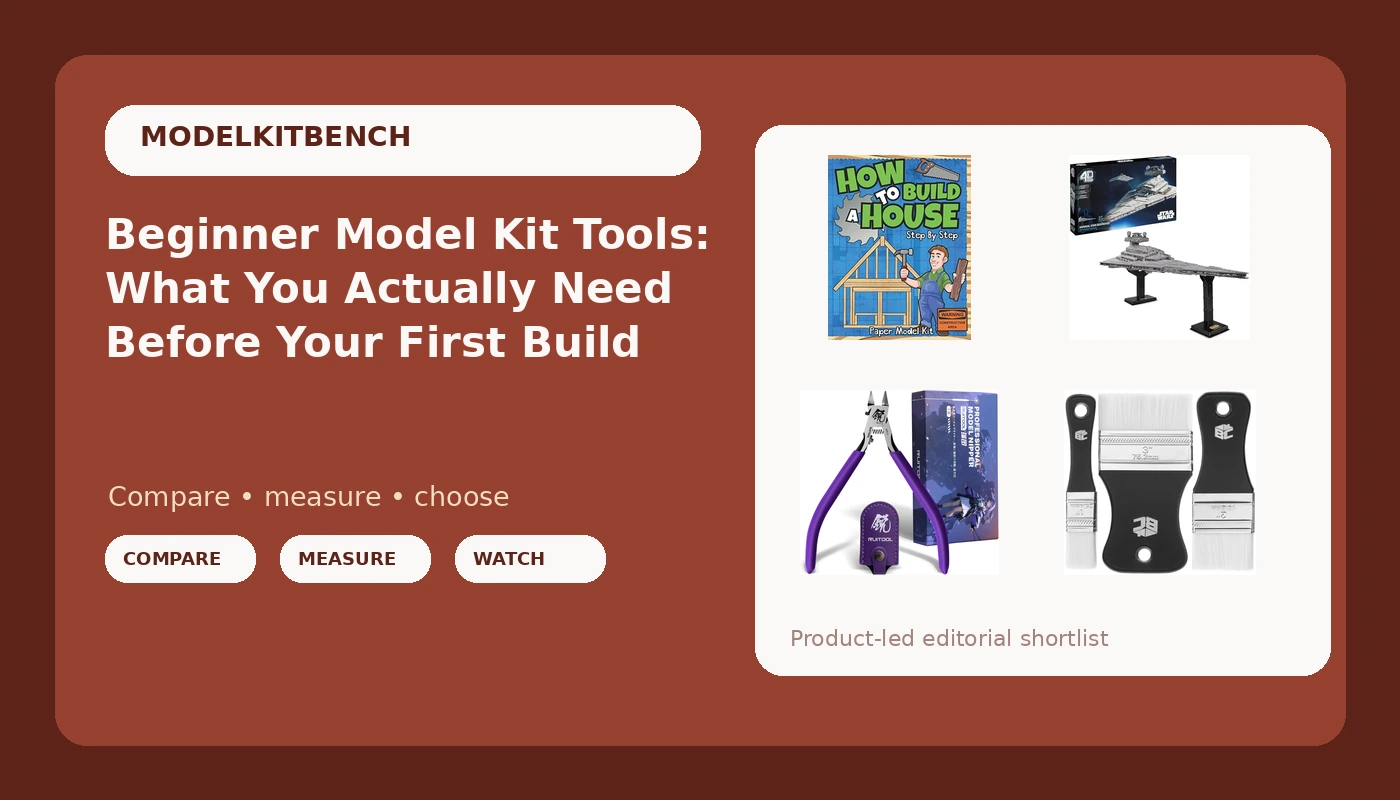
Most beginners ask the wrong question first. They ask which kit to buy, when the thing that decides whether the build goes well is what sits on the bench next to the box. This explainer covers beginner model kit tools and first kits, and how the two fit together: a cutting tool that takes parts off the runner without chewing them up, a paper model that teaches construction sequence, a 278 piece display kit for a shelf, and a flat brush set for the day you decide to paint. You do not need all four. You need to know which problem each one solves before you spend anything.
Related: Panel Lining for Beginners: One Pass, One Big Difference →
Quick answer
Start with the cut. A nipper is the first tool worth buying, because every plastic kit begins the same way, with parts attached to a runner and a builder trying not to damage them. A single blade nipper marketed for Gunpla is the most direct answer for a beginner, and it is the tool most people skip until their first set of nub marks teaches them otherwise. After that, pick a kit that matches the skill you want to practice. Paper models teach structure and sequence, 3D puzzle kits teach patience, and a flat brush set only matters if you plan to hand paint. None of these need aftermarket parts to be useful.
4 useful options
| Model | Best fit | What stands out |
|---|---|---|
| RUITOOL Model Nippers for Beginners, 4.7" Single Blade Nipper for Gunpla | Cutting parts off the runner | Single blade design aimed at Gunpla and positioned for beginners |
| How To Build A House: Step By Step Paper Model Kit | Learning construction methods without plastic | Step by step paper build focused on building techniques |
| 4D Build, Star Wars Deluxe Imperial Star Destroyer 3D Model Kit | A desk piece that doubles as a puzzle | 278 pieces, listed for ages 12 and up |
| Bates- Flat Paddle Paint Brush Set, 3 Pack, 1"/2"/3" Nylon Bristles | Broad coverage when hand painting | Three flat paddle widths with nylon bristles |
The nipper: RUITOOL Model Nippers for Beginners, 4.7" Single Blade Nipper for Gunpla
Here is why the nipper comes first and not the kit. A plastic part leaves the runner with a small stub of plastic, the nub, still attached. Where that nub lands and how much material comes with it decides how much sanding you do later, and sanding is where beginners lose parts, flatten detail, and scratch surfaces. A single blade nipper is built with one cutting edge and one flat face, which is the geometry that lets you get close to the part instead of clipping through the middle of the gate. It is not a magic tool. Technique still matters, and a second, lighter cut to remove the remaining stub is normal practice. But a dedicated nipper beats household cutters, which crush plastic rather than slice it, and crushed plastic leaves a white stress mark that no amount of sanding fully removes. The beginner labeling on this one matters less than the blade type. If you are buying one tool for your first build, buy the one shaped for the job.
The practice kit: How To Build A House: Step By Step Paper Model Kit | For Kids To Learn Construction Methods And Building Techniques With Paper Crafts (How To Build Things)
Paper is an underrated trainer, and not only for kids. Paper models fold, tab, and slot together, which means every step has an order and a consequence. Skip a fold and the wall does not sit square. Glue a tab to the wrong face and you find out three steps later. That is the same lesson plastic kits teach with gates and polycaps, just without the knife work. What paper does not teach is runner management, nub cleanup, or how snap-fit joints feel when they seat properly. So treat this one as a sequencing exercise and a low-risk way to find out whether you enjoy the assembly process at all before you buy a stack of plastic. It is also the option here that works as a shared project with a younger builder, since the listing frames it for kids and for learning how structures go together.
The display kit: 4D Build, Star Wars Deluxe Imperial Star Destroyer 3D Model Kit, Star Wars Collectibles & Desk Decor, Adult Puzzle, Building Toys, 278 Pieces, 3D Puzzles, Gift Ideas for Ages 12 & Up
Puzzle-style 3D kits are a different discipline from plastic model building, and it helps to know that going in. There are no runners, no nippers, and no nub marks. Instead you get flat pieces that key into each other, and the challenge is reading the sequence correctly and being patient when a section wants to be assembled in a specific order. With 278 pieces, this is a build measured in evenings rather than an afternoon, which is exactly why the listing frames it for ages 12 and up and for adults. The trade-off is adjustment. Where a snap-fit plastic kit either seats or does not, slotted construction can be fussy about alignment, and forcing a joint is how pieces get creased. If your goal is a Star Wars piece for a desk rather than practice with hobby tools, this is the category that delivers that with no paint and no cleanup.
The brush set: Bates- Flat Paddle Paint Brush Set, 3 Pack, 1"/2"/3" Nylon Bristles
Flat paddle brushes are not the tool you use for detail work, and that is the point. A wide flat brush lays down a base coat across a large surface in fewer passes, which means less streaking and less chance of paint drying on the edge before you blend the next stroke. Sizes this broad suit priming, large armor panels, terrain, and paper or card projects more than they suit a 1/144 scale shoulder. If you plan to paint small models, you will eventually want a couple of round brushes for tight areas and a fine liner for panel details, but those are not the first brushes a beginner needs. Nylon bristles are the standard budget choice, and they tolerate water-based acrylics well. The maintenance rule is the same at any price: clean the bristles promptly, keep paint out of the ferrule where the bristles meet the handle, and dry the brush bristle-down or flat.
Prices and availability may change. Product images, names, and retailer links are matched to verified listings. No current price, rating, stock status, or measured result is stated here without current evidence.
What a beginner bench actually needs
The honest answer is less than the internet suggests. You need a cutting tool, a way to clean up the cut, and a kit. That is the whole starter kit. A single blade nipper handles the first job. Sanding sticks or fine abrasive pads handle the second, and a hobby knife is useful for trimming stubborn stubs, though it is also the tool most likely to slice a fingertip, so it earns its place only after you are comfortable. Tweezers matter more than people expect, because decals and small polycaps are hard to place with fingers. A tray or a small box for parts prevents the classic disaster of a tiny piece rolling off the desk mid-build. None of that is expensive, and none of it is optional once you start working on anything with more than a hundred parts. What you can safely postpone is paint, an airbrush, and every aftermarket detail part, because those change how a finished model looks, not whether it goes together.
How to choose your first kit and tool set
- Decide what you actually want to practice. Cutting and cleanup, painting, or assembly sequencing are three different skills, and the best first purchase depends on which one you are chasing.
- Start with the cut, not the paint. A nipper and a sanding method solve the problem every plastic kit puts in front of you in the first ten minutes.
- Match the kit to your tolerance for fragility. Small, highly detailed kits with dense inner frames look impressive but are less forgiving to handle than simpler builds with fewer, larger parts.
- Read the listing for piece count and age guidance before you buy. A 278 piece puzzle kit and a 60 part snap-fit kit ask for very different patience levels.
- Plan where the finished model goes before you start. A shelf, a case, or a desk spot shapes what you build and how much you care about the finish.
Practical guidance that saves rework
- Make the first cut away from the part, then trim the remaining stub with a second, lighter cut closer to the surface.
- Keep your nipper for plastic only. Cutting wire, resin, or card dulls an edge that is meant to slice.
- Work over a tray or a shallow box so small parts cannot escape onto the floor.
- Follow the instruction sheet sequence. Kit manuals are written in an order that keeps sub-assemblies accessible, and skipping ahead usually creates a part you cannot reach later.
- If you plan to paint, test your brush and thinner on a spare part or a plastic spoon before committing to a visible surface.
Which option should you choose?
Choose the RUITOOL Model Nippers for Beginners when your problem is the cut, which is most beginners on their first plastic kit. Choose the How To Build A House paper model kit when you want to learn construction sequence and structure in a low-risk format, especially with a younger builder involved. Choose the 4D Build Star Wars Deluxe Imperial Star Destroyer when you want a large piece of desk decor and enjoy a puzzle-style assembly rather than plastic model technique. Choose the Bates Flat Paddle Paint Brush Set when you intend to hand paint large surfaces and need broad coverage rather than fine detail work.
The caveat is straightforward. These listings describe what each product is and how it is positioned, and none of them states a measured result. Nothing here claims a cut quality, a paint finish, or an assembly difficulty that was tested, and no current price or rating is quoted. Treat the descriptions as a starting point, then read the listing details yourself.
The bottom line
The order matters more than the shopping list. Buy the cutting tool first, because it affects every kit you will ever open. Add a cleanup method at the same time, since a nipper without sanding just moves the problem. Then pick one kit that matches the skill you want to develop, whether that is structure with paper, sequencing with a large puzzle build, or straight plastic assembly. Paint brushes come last, and only if you have decided to paint. Get the first three right and your second kit will go noticeably better than your first.