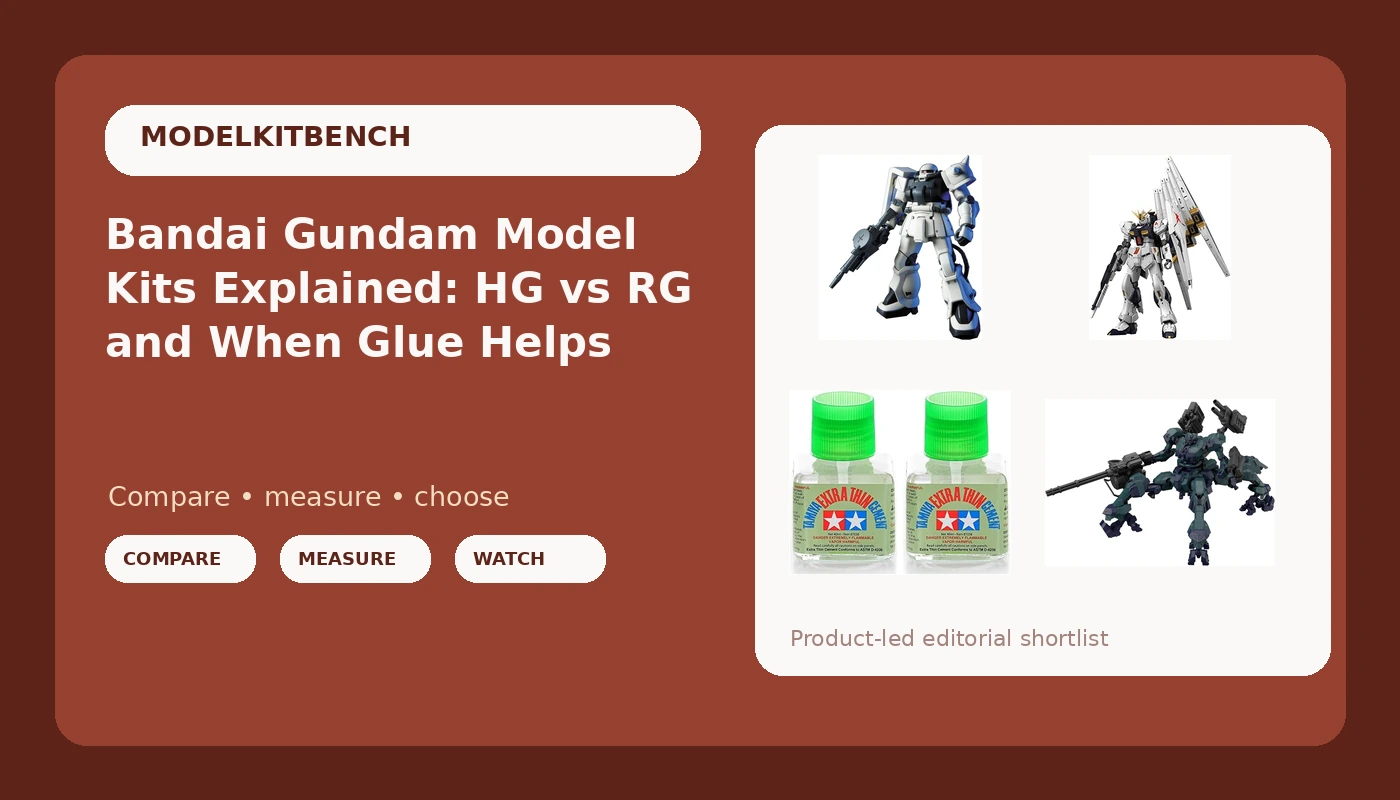
Standing in front of a hobby shop wall of white and blue boxes, the first thing that stops you is the lettering. HG, RG, MG, 30MM, 1/144, 1/100. All of it describes Bandai Gundam model kits and the Bandai lines that share their engineering, and none of it tells you plainly what happens once you cut the tape. Two kits can sit at the same scale and deliver completely different evenings: one clicks together with no cement at all, the other rewards a bottle of extra thin cement because the joins want to be welded rather than pressed. The label is a promise about engineering, not a difficulty rating. This explainer covers what the common grade labels actually mean, how part fit and gate placement decide whether a build feels good in your hands, and where a tool like Tamiya extra thin cement fits into a hobby that keeps telling you glue is optional. Four verified listings are below, each matched to a specific job on the bench.
Related: HG vs RG vs MG: How Gunpla Grades Compare →
Quick answer
The grade label tells you scale and internal detail, not how hard a kit is. HG kits are 1/144 scale, usually the most affordable way in, and modern ones are designed to snap together without cement. RG kits are also 1/144 but pack an inner frame and far more parts, so they ask more patience during assembly. The 30MM label marks Bandai's quick-build mecha line, which shares that snap-fit philosophy and works well for builders who want a non-Gundam subject. Extra thin cement is not a requirement for any of those kits; it is a bench tool for seam work, welded joints, and any model that is not snap-fit by design.
Four useful options
| Model | Best fit | What stands out |
|---|---|---|
| Armored Core VI BD-011 Melander Liger Tail 30 MM 1/144 | Builders who want a mecha subject outside the Gundam timeline | A 1/144 Armored Core VI kit from the quick-build 30MM line |
| Gundam 0083 MS-06F-2 Zaku II F2 (EFSF Ver.) HGUC 1/144 | A first or second Bandai build at 1/144 | A numbered HGUC kit with the EFSF variant color scheme |
| RG 1/144 #32 Nu Gundam Char's Counterattack | Builders chasing detail and an inner frame | A Real Grade entry from Char's Counterattack with the RG inner frame approach |
| Tamiya 87038 Extra Thin Cement 40ml 2 Pack | Seam filling, welded joins, and non-snap kits | Extra thin solvent cement with a fine applicator, sold as a two pack |
The mecha alternative: Bandai Hobby - Armored Core VI Fires of Rubicon - #03 Balam Industries BD-011 Melander Liger Tail 30 MM 1/144 Model Kit
The appeal here is subject matter. If you have built a shelf of Gundam and want something with a different silhouette, an Armored Core VI machine gives you a squat, armored frame that does not read like any mobile suit. The 30MM tag is the useful part of the label: it signals a kit built around fast, accessible assembly rather than a dense inner frame, which makes it a reasonable pick for a weekend build or for a builder who wants to practice weathering and chipping on a mecha body. The trade-off is the same one that applies to any 1/144 kit. Small parts mean small nubs, and small nubs mean your sanding discipline shows up close in photographs.
The first HG: Bandai Hobby - Gundam 0083 - #107 MS-06F-2 Zaku II F2 (EFSF Ver.), Bandai Spirits HGUC 1/144 Model Kit
The Zaku is the honest test of a kit line, because the design is all tubes, curves, and a single eye. There is nowhere to hide a lazy gate or a sloppy seam. A modern HGUC Zaku at this scale is the kind of kit that teaches the hobby's first skills properly: cutting a part off the runner with nippers and leaving a little plastic, then shaving the nub flush instead of tearing it. Because the EFSF version uses a different color scheme than the standard green, it also gives you a reason to think about paint before you even open the box. If you want to practice color separation and masking on a kit you can replace easily, a High Grade in a non-default scheme is a sensible choice.
The RG showcase: Bandai Hobby RG 1/144#32 Nu Gundam Char's Counterattack
RG kits are where Bandai shows off engineering, and the Nu Gundam is a good example of why the line gets that reputation. You get an inner frame, layered armor, and mechanical detail that an HG at the same scale simply does not carry. The cost is assembly density. More parts mean more cuts, more nubs, and more places where a rushed step shows. The other trade-off is handling: a kit with a dense internal structure rewards careful posing more than constant re-posing, so if you like to fiddle with a finished build every day, an HG will forgive you faster. If you want the detail without moving up to a larger scale, RG is the lane.
The bench tool: Tamiya 87038 Extra Thin Cement Glue Fine Tip 40ml 2 Pack
Here is the part that confuses beginners: Bandai snap-fit kits do not need cement, and using it carelessly can fog clear parts or weld a joint you wanted to keep movable. Extra thin cement earns its place in three situations. First, seam filling on kits that show a seam down a curved surface. Second, welded joints on models designed for glue, including most military and automotive subjects. Third, reinforcing a joint that you never intend to move again, where a thin bead wicked into the gap creates a bond that is stronger than the snap fit alone. The thin formula matters because it flows into the joint instead of sitting on top of it, and the fine tip matters because a puddle of solvent on bare plastic leaves a scar you cannot sand out.
Prices and availability may change. Product images, names, and retailer links are matched to verified listings. No current price, rating, stock status, or measured result is stated here without current evidence.
What "snap-fit" actually means on a Bandai runner
Snap-fit means the parts are engineered with pegs, sockets, and friction tolerances that hold without adhesive. It does not mean the kit is simple, and it does not mean the joints are permanent. A well-engineered snap-fit joint holds because the peg diameter and the socket diameter are matched closely enough that friction does the work, which is also why a poorly engineered kit feels loose the moment you move it. This is where gate placement enters the conversation. A gate is the small channel of plastic connecting a part to the runner frame. When the gate sits on a visible surface, you are forced to sand and polish, and on a colored part you risk dulling the finish. When the gate is tucked under the part, the leftover mark disappears into a hidden face. Under-gated parts are a sign that someone thought about the builder, and they are one of the clearest differences between a kit designed last year and one designed twenty years ago.
Scale and grade are separate ideas, which trips up a lot of first purchases. HG and RG are both 1/144, so a finished HG Zaku and a finished RG Nu Gundam stand at comparable heights. What changes is what is inside. HG kits prioritize a clean silhouette and a manageable part count. RG kits add an inner frame and finer surface detail at the same size, which is impressive and also more demanding. The 30MM line is a third approach: quick assembly as the design goal, with a mecha subject that is not a Gundam. None of these labels tells you a kit is easy. They tell you what kind of evening you are signing up for.
How to pick a kit and set up the bench
- Decide the scale first, because 1/144 fits on a shelf and a desk while larger scales need real space.
- Pick the subject second, since a design you actually like will keep you sanding long after a design you settled for.
- Read the grade label as an engineering hint: HG for a straightforward build, RG for detail and density, 30MM for a fast mecha build.
- Check whether the kit is snap-fit before you buy cement, and treat cement as a tool for seams and fixed joints rather than a default step.
- Plan your finish before assembly, because a painted build wants sub-assemblies and masked joints, while a straight build wants clean nub removal and panel lining.
Practical guidance for the first three builds
- Buy good nippers before you buy anything else. A flush cut close to the part saves more cleanup time than any other tool.
- Cut parts off the runner leaving a short stub, then shave the stub flush in thin passes instead of tearing it off in one squeeze.
- Keep a dedicated sanding sequence, usually a medium grit followed by a fine grit, and replace worn paper rather than pressing harder.
- Test-fit a joint before you commit to cement, since a snap-fit joint that already holds does not need solvent.
- Panel line after assembly on a matte or semi-gloss surface, and let the ink dry fully before you touch the part again.
- Store decals and cement away from direct sun, because heat is the enemy of both.
Which option should you choose?
Choose the Bandai Hobby - Armored Core VI Fires of Rubicon - #03 Balam Industries BD-011 Melander Liger Tail 30 MM 1/144 Model Kit when you want a mecha subject outside the Gundam timeline and a build that leans toward quick assembly. Choose the Bandai Hobby - Gundam 0083 - #107 MS-06F-2 Zaku II F2 (EFSF Ver.), Bandai Spirits HGUC 1/144 Model Kit when you want a first or second High Grade at 1/144 in a non-standard color scheme. Choose the Bandai Hobby RG 1/144#32 Nu Gundam Char's Counterattack when you want an inner frame and heavier detail without moving up in scale. Choose the Tamiya 87038 Extra Thin Cement Glue Fine Tip 40ml 2 Pack when your builds involve seam work, welded joins, or kits that are not snap-fit by design.
A caveat worth stating plainly: the right choice depends on what you plan to do with the finished model. A kit that is a joy to assemble can still be a poor match for a builder who wants to repaint every surface, and a detail-heavy kit can be the wrong first purchase for someone who has never sanded a nub. Match the kit to the bench, not to the box art.
The bottom line
Bandai Gundam model kits are labeled by grade and scale, and those two facts tell you most of what you need to know before checkout. HG at 1/144 is the standard entry point and the Zaku II F2 covers it in a color scheme that invites paint practice. RG at the same scale adds an inner frame and the part density that comes with it, which is the Nu Gundam's lane. The 30MM Armored Core kit serves builders who want a different silhouette and a faster assembly. Tamiya extra thin cement sits outside the snap-fit conversation entirely, and that is the point: it is a seam and weld tool, not a required step for modern Bandai kits. Buy the kit that matches your shelf and your patience, and let the sprue tell you the truth when it arrives.